
AI did not slow down this week. In just six days, the conversation moved from smarter chatbots to enterprise AI deployment, brain-to-text systems, regulatory pressure, and the massive debt machine funding the AI boom.
From 27 June to 2 July 2026, the most important AI stories were not only about bigger models. The real theme was control: who controls enterprise AI adoption, who controls AI policy, who controls scientific workflows, who controls brain-computer data, and who pays for the infrastructure behind it all.
This week’s top AI stories at a glance
Microsoft creates a $2.5B company for enterprise AI adoption
AI value shifts from model access to implementation, data integration and measurable ROI
Reuters, Business InsiderFTC AI bias policy sparks a fight over chatbot safeguards
AI fairness, federal law and state regulation collide in a new policy battle
Reuters, AxiosAnthropic launches Claude Science for research and pharma
Frontier AI moves into specialized, high-value scientific workflows
Reuters, Financial TimesMeta Brain2Qwerty v2 reaches 61% word accuracy
Non-invasive brain-to-text research moves closer to a measurable AI interface
Meta AI, Meta AI ResearchAI infrastructure debt becomes a hidden force behind the boom
Chips, data centers and cloud growth pull debt markets deeper into AI expansion
Reuters market analysis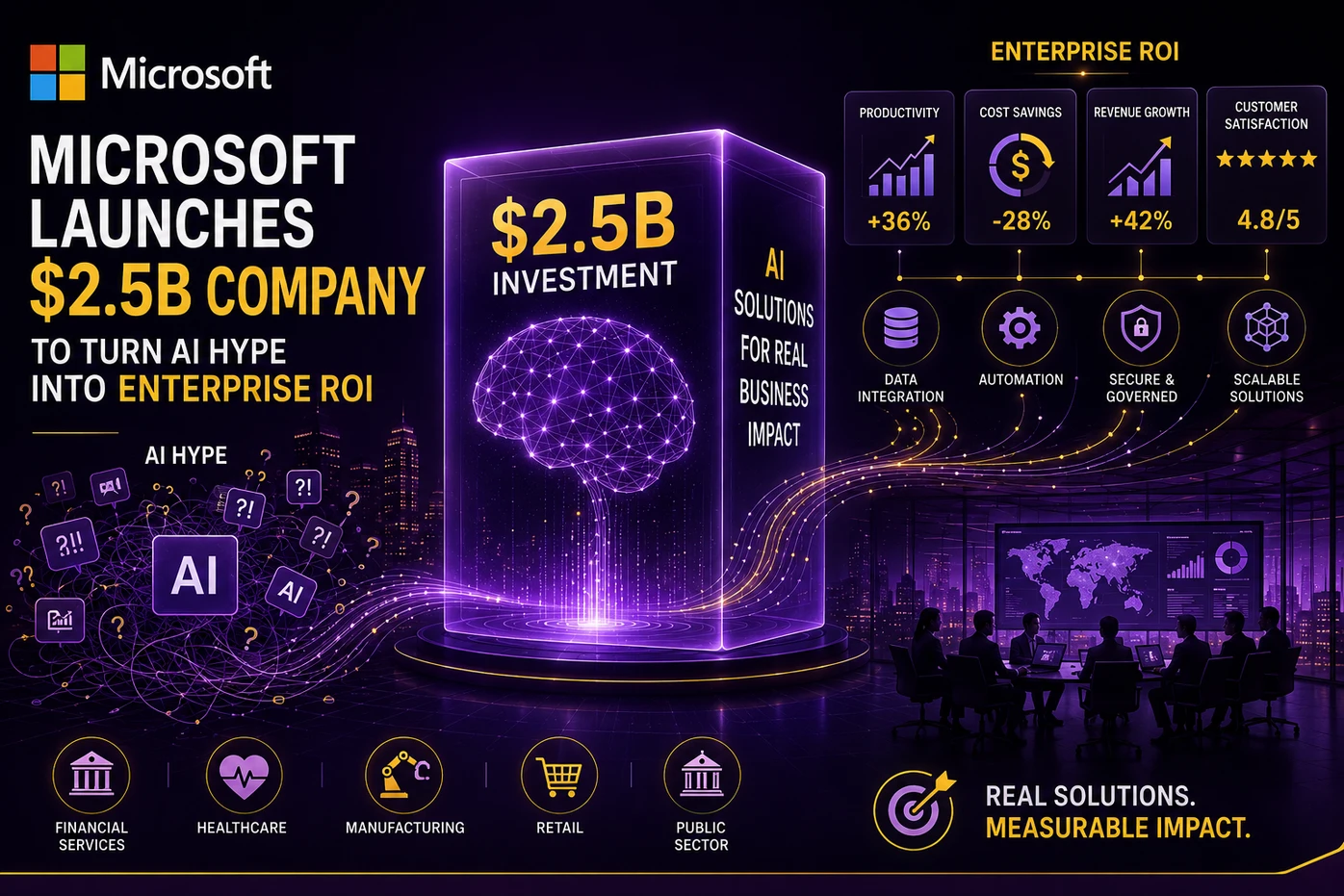
Microsoft launches a $2.5B company to turn AI hype into enterprise ROI
What happened
Microsoft said on 2 July 2026 that it is creating Microsoft Frontier Company, a new operating entity funded with $2.5 billion to help major customers choose, customize, and integrate AI technologies with their own internal data. Reuters reported that early clients include Unilever and Novo Nordisk, and that the firm will help companies use Microsoft and non-Microsoft models rather than locking into a single provider. Business Insider, in a 27 June interview-based report, also highlighted Satya Nadella's argument that companies should build AI around their own data and learning systems rather than outsource all intelligence to a small set of frontier models.
Why it matters
This is a major sign that the enterprise AI battle is moving beyond model benchmarks. The next money layer is implementation: data integration, model selection, fine-tuning, governance, and measurable business returns.
The bigger picture
Microsoft is effectively saying that AI success will not come from simply buying access to one chatbot. It will come from building AI systems that understand a company's internal context. That matters for agencies, consultancies, SaaS vendors, CRM providers, and AI automation businesses.
Reader hook
The AI race is no longer only about who has the smartest model. It is about who can install AI inside real companies and prove it makes money.
Viral angle
The viral angle is simple: Microsoft admitted the market needs flexibility, not one-model dependency. For business audiences, that is more important than another benchmark chart.
Who should care
Enterprise leaders, AI consultants, agencies, CRM builders, SaaS companies, developers, and investors.
Practical meaning
Businesses should prepare for multi-model AI stacks: OpenAI for some tasks, Anthropic or open models for others, and internal data layers that make the AI useful. AI agencies can position themselves around deployment and ROI instead of generic chatbot setup.
Controversy and debate
The debate is whether Microsoft is protecting customers from model lock-in or creating a new services layer that keeps enterprises dependent on Microsoft-led integration.
Social media signals
Verifiable public signal: Reuters treated it as a major business AI story on 2 July, and Business Insider had already amplified Nadella's multi-model view on 27 June. No unverified X or LinkedIn engagement numbers are included.
Why this went viral
It connected three hot topics at once: AI ROI, model lock-in, and the rise of forward-deployed AI engineering.
What happens next
Watch whether Microsoft Frontier Company becomes a full consulting-style AI deployment arm and whether rivals such as AWS, Palantir, Google Cloud, and OpenAI respond with similar enterprise implementation units.
FTC AI bias policy sparks a new fight over chatbot safeguards
What happened
Reuters reported on 1 July 2026 that the U.S. Federal Trade Commission said AI companies whose chatbots produce responses reflecting "ideological objectives" may violate federal law, as part of a proposed policy on applying FTC authority to AI. Reuters also reported that training chatbots to avoid responses that discriminate against protected groups could run into Section 5 issues, and that the FTC will accept public comment until 31 July. Axios added context on 2 July, reporting that the FTC is operating in a changed power environment after a Supreme Court ruling strengthened presidential control over the agency and that the FTC is also arguing federal preemption over conflicting state AI laws.
Why it matters
This matters because it turns AI safety and fairness into a legal battlefield. AI companies may now face tension between avoiding discriminatory outputs, following state AI laws, and avoiding federal claims that their chatbot behavior is ideologically shaped or deceptive.
The bigger picture
AI governance is becoming fragmented. The same model behavior could be viewed as consumer protection, censorship, fairness, or political bias depending on which regulator is looking at it.
Reader hook
The surprising question of the week: could making an AI less biased create a different legal risk?
Viral angle
This story has obvious viral fuel because it combines AI bias, politics, free speech, consumer protection, and state-versus-federal regulation.
Who should care
AI companies, legal teams, compliance officers, product safety teams, marketers using AI tools, and any business deploying chatbots in regulated contexts.
Practical meaning
Companies should document why their AI safeguards exist, how they are tested, and how they avoid misleading users. Marketing teams should avoid claiming that their AI is neutral, unbiased, or fully compliant unless those claims are substantiated.
Controversy and debate
Supporters may frame the policy as a check on ideological manipulation. Critics may argue it weakens anti-discrimination safeguards and creates uncertainty for state-level AI rules.
Social media signals
Verifiable public signal: Reuters published the policy clash on 1 July, and Axios followed with broader FTC power-context coverage on 2 July. No unverified social media metrics are included.
Why this went viral
It gave people a provocative headline: "AI bias safeguards might break the law." That is easy to discuss, argue about, and share.
What happens next
Watch the public comment period through 31 July and whether state AI law supporters challenge the FTC's preemption position.
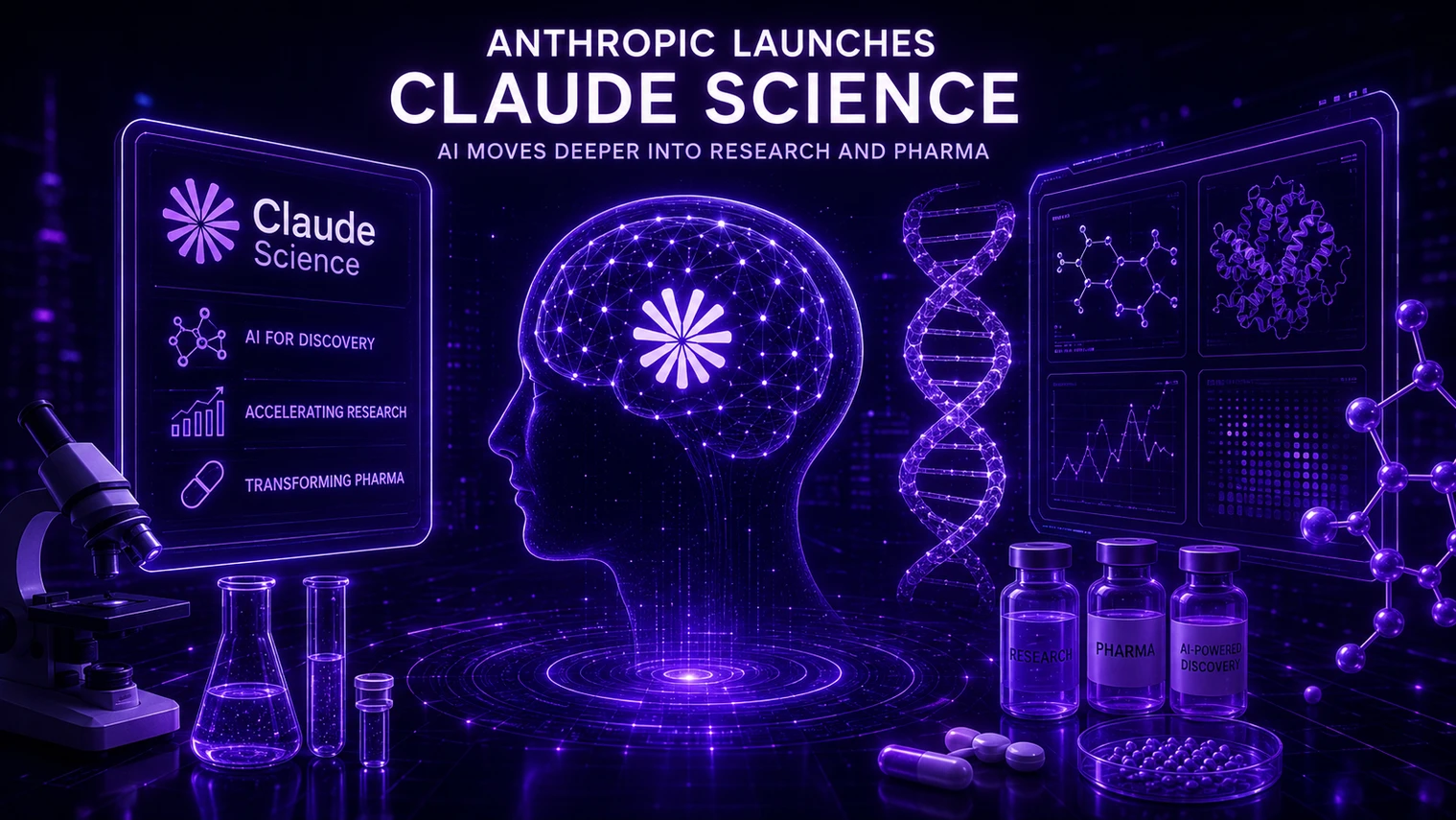
Anthropic launches Claude Science as AI moves deeper into research and pharma
What happened
On 30 June 2026, Reuters reported that Anthropic launched Claude Science, an AI research workbench designed to help scientists streamline research, analyze data, and manage complex computing workflows. The Financial Times also reported the launch, describing it as a push into scientific and pharmaceutical revenue, with features relevant to drug discovery and life sciences work.
Why it matters
This story matters because frontier AI companies are no longer only selling general chatbots. They are building vertical workbenches for high-value professional fields where accuracy, workflow design, and domain-specific controls matter.
The bigger picture
AI for science is becoming one of the most important enterprise battlegrounds. The companies that win here could become embedded in pharma, biotech, materials science, climate research, and academic labs.
Reader hook
Claude is not just answering questions anymore. Anthropic wants it inside the scientific workflow.
Viral angle
The viral angle is the move from "AI assistant" to "AI research colleague." That is more concrete for scientists and businesses than generic model updates.
Who should care
Scientists, pharma companies, biotech founders, research labs, universities, healthcare investors, and AI product builders.
Practical meaning
Businesses in technical industries should watch for specialized AI workbenches rather than relying only on generic chat interfaces. Marketers should also note the positioning shift: "AI for workflows" is stronger than "AI for everything."
Controversy and debate
The debate is safety. Tools that help with scientific discovery can also raise questions about sensitive biological workflows, controlled access, and misuse risk.
Social media signals
Verifiable public signal: Reuters and the Financial Times both covered the launch inside the requested date range. No unverifiable Reddit, X, or LinkedIn activity is included.
Why this went viral
It sits at the intersection of AI, pharma, scientific productivity, and frontier model safety.
What happens next
Watch whether Anthropic opens Claude Science broadly, limits advanced biological workflows to vetted users, or expands it through partnerships with pharma and research institutions.
Meta Brain2Qwerty v2 turns brain signals into text with 61% word accuracy
What happened
Meta AI announced Brain2Qwerty v2 on 29 June 2026, describing it as a non-invasive brain-to-text system that decodes natural sentences from real-time MEG brain recordings. Meta reported that the system used approximately 22,000 sentences from nine participants, each recorded for 10 hours, and achieved a 61% word accuracy rate, with the best participant reaching 78% word accuracy. Meta also published a research page for the paper, "Accurate Decoding of Natural Sentences from Non-Invasive Brain Recordings," which reports an average word error rate of 39%.
Why it matters
This is one of the week's most attention-grabbing research stories because it makes brain-computer interfaces feel less like science fiction and more like a measurable AI research path.
The bigger picture
Non-invasive brain-to-text is still early and not a consumer product, but it points toward a future where AI interfaces may expand beyond typing, voice, and screens. It also raises serious questions around consent, neural data, and mental privacy.
Reader hook
What if one day you could communicate by thinking instead of speaking or typing?
Viral angle
The phrase "AI reads brain waves into text" is naturally viral. It is easy to understand, emotionally powerful, and slightly unsettling.
Who should care
Neuroscience researchers, accessibility advocates, medical technologists, AI researchers, ethicists, privacy advocates, and future interface designers.
Practical meaning
For now, this is research. The practical near-term value is in assistive communication, brain data modeling, and new research methods. Businesses should avoid overclaiming consumer use cases until the technology is validated outside controlled lab settings.
Controversy and debate
The main debate is mental privacy. Even if today's work requires consent and specialized MEG equipment, progress in brain decoding will force society to define rules for neural data.
Social media signals
Verifiable public signal: Meta published both the official blog and research publication on 29 June. No unverified claims that hashtags trended or that specific posts went viral are included.
Why this went viral
It combines a simple sci-fi idea with a concrete number: 61% word accuracy.
What happens next
Watch for independent replication, clinical pilots, dataset releases, and ethics frameworks around neural data.
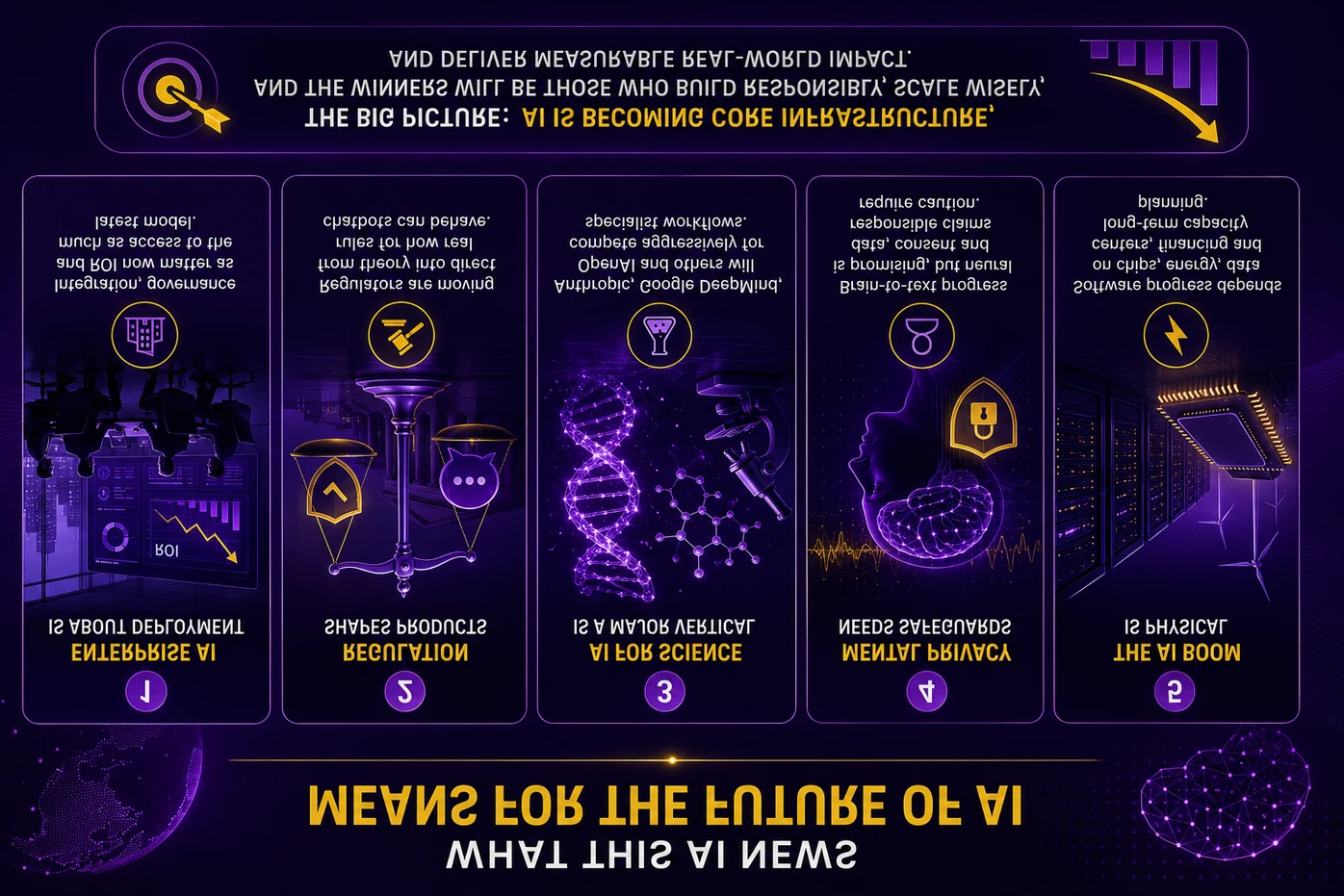
What this AI news means for the future of AI
The clearest signal from this period is that AI is moving from novelty to infrastructure. Enterprise deployment is becoming a services business. Scientific AI is becoming a specialized product category. Regulation is becoming a direct product-design concern. Brain-computer research is pushing AI into new interfaces. And the financial system is being pulled deeper into the AI buildout through debt and capex.
Enterprise AI is about deployment
Integration, governance and ROI now matter as much as access to the latest model.
Regulation shapes products
Regulators are moving from theory into direct rules for how real chatbots can behave.
AI for science is a major vertical
Anthropic, Google DeepMind, OpenAI and others will compete aggressively for specialist workflows.
Mental privacy needs safeguards
Brain-to-text progress is promising, but neural data, consent and responsible claims require caution.
The AI boom is physical
Software progress depends on chips, energy, data centers, financing and long-term capacity planning.
The AI shift everyone should watch next
The next major shift to watch is the rise of AI deployment companies and forward-deployed AI engineers. The market is moving from "which model is smartest?" to "who can make AI work inside real companies?" This is a major opportunity for AI consultants, agencies, CRM builders, workflow automation providers, and enterprise software teams.
Conclusion
Between 27 June and 2 July 2026, AI news showed a clear pattern: the industry is becoming more practical, more regulated, more capital-intensive, and more deeply embedded in science and business. The companies that win the next phase of AI will not only build smarter models. They will help organizations deploy those models safely, profitably, and responsibly.
Deploy practical AI agents and workflows around your business goals.
AI Course for BeginnersLearn the practical AI tools and workflows worth using today.
AI SEO and AEO OptimizationImprove visibility across Google and AI answer engines.
Latest AI News and UpdatesFollow Market Me Global for weekly AI news and business insights.
Frequently asked questions
What were the biggest AI news stories from 27 June to 2 July 2026?
The biggest verified stories were Microsoft launching a $2.5B AI adoption company, the FTC policy clash over chatbot bias safeguards, Anthropic launching Claude Science, Meta publishing Brain2Qwerty v2, and Reuters reporting that AI infrastructure spending is reshaping debt markets.
Which AI company made the biggest announcement?
For business impact, Microsoft made the biggest enterprise announcement with Microsoft Frontier Company. For research impact, Meta’s Brain2Qwerty v2 was the most attention-grabbing. For science and pharma workflows, Anthropic’s Claude Science was the key launch.
Why are these AI updates important?
They show AI shifting from general chatbot hype into enterprise deployment, regulation, scientific workflows, brain-computer research, and infrastructure financing.
How will these AI news stories affect businesses?
Businesses will need clearer AI strategies, stronger governance, multi-model flexibility, careful legal review, and practical deployment partners that can connect AI to internal data and measurable ROI.
What should marketers, creators, and developers watch next?
Watch enterprise AI deployment, AI compliance rules, specialized AI tools for industries, and whether model providers move deeper into services, consulting, and workflow automation.
That is the verified AI news window from 27 June to 2 July 2026: enterprise deployment, chatbot regulation, specialist science tools, brain-to-text research and the debt financing the infrastructure boom. Follow Market Me Global for the next roundup.