
Quick Summary For Busy Readers
While much of the world slowed down for the holiday window, AI policy and business strategy accelerated. The UN opened its first Global Dialogue on AI Governance in Geneva, Takeda committed up to $600 million to an AI drug discovery partnership, xAI completed its SpaceXAI identity shift, Tesla placed a cap on third-party AI tool spending, China moved against AI companion features, and a new AI for Good Global Commission put heads of state and enterprise software leaders around the same table.
UN's Guterres Warns AI Is Outpacing Oversight
What happened: On July 6, UN Secretary-General Antonio Guterres opened the first Global Dialogue on AI Governance in Geneva, putting all 193 member states into the same formal policy conversation. The focus: AI is moving faster than many institutions can test, govern or safely deploy it.
Why it matters: The discussion around a Global Fund for AI, child-safety testing and international baseline rules is a preview of the compliance questions ordinary businesses will face next. If your company uses AI to talk to customers, screen users, personalize content or support minors, the governance conversation is no longer abstract.
The bigger picture: The UN's AI work sits alongside rising concern about inequality, deepfakes, child safety and autonomous weapons. The practical signal for businesses is simple: start documenting how AI tools are tested, monitored and escalated before formal rules force the issue.
Takeda And Insilico Medicine Strike AI Drug Discovery Deal Worth Up To $600 Million
What happened: Takeda Pharmaceutical and Insilico Medicine announced a strategic collaboration that uses Insilico's Pharma.AI platform to discover drug candidates across Takeda's core therapeutic areas. The structure includes about $60 million in upfront and near-term payments, with potential milestones lifting the total to roughly $600 million plus royalties.
Why it matters: This is AI moving from slide decks into regulated, high-value workflows. Pharma companies are not treating generative AI as a novelty; they are putting it into research pipelines where the upside can be measured in years saved, better candidate selection and new commercial rights.
The bigger picture: The same pattern applies outside biotech. Once AI systems become reliable enough to own full workflows, companies stop asking whether AI can help and start asking which parts of the operating model should be rebuilt around it.
xAI Officially Rebrands As SpaceXAI
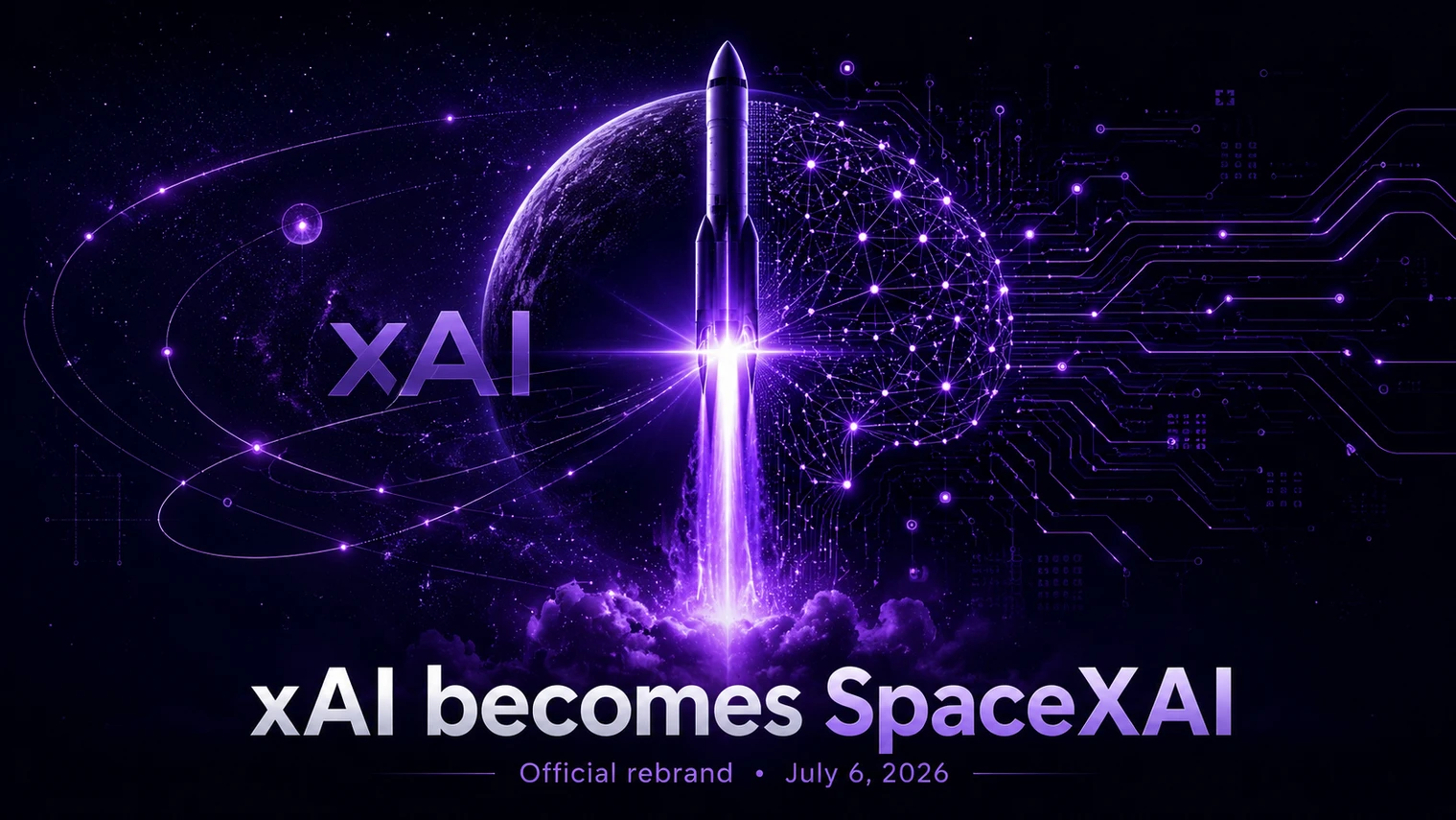
What happened: Elon Musk's xAI completed its SpaceXAI rebrand on July 6, changing its identity and logo after months of deeper integration with SpaceX. The new positioning makes the point loudly: AI is now central to the SpaceX story, not a side venture.
Why it matters: Frontier AI has become expensive enough that independent labs increasingly need the balance sheets, infrastructure and distribution power of much larger companies. For businesses buying AI tools, this is a reminder to evaluate vendor stability, ownership and long-term product direction.
The bigger picture: Space, satellites, data centers and AI compute are now being talked about as one connected infrastructure layer. Whether SpaceXAI becomes a dominant AI vendor or not, the rebrand shows how quickly AI companies are being absorbed into broader industrial strategies.
Tesla Caps Employee AI Spending At $200 A Week

What happened: Tesla told employees that third-party AI tool spending would be capped at $200 per employee per week, with higher spend requiring manager approval. The cap reportedly excludes Musk-linked tools such as Grok and Composer.
Why it matters: This is the enterprise AI honeymoon ending. Companies encouraged wide experimentation, saw usage-based bills climb, then started building controls. AI adoption is becoming a managed budget line rather than an open tab.
The bigger picture: Uber, Meta, Amazon and Walmart have also moved toward AI spending controls. Any business rolling out AI agents, coding assistants or AI research tools should track usage before surprise costs force a rushed policy reversal.
China Pushes AI Companion Features Into A Stricter Category
What happened: ByteDance's Doubao and Alibaba's Qwen moved to disable or limit AI companion and persona-style features ahead of China's tighter rules for anthropomorphic AI interaction services. These systems simulate personality, memory and sustained emotional interaction, which regulators are increasingly treating differently from ordinary business chatbots.
Why it matters: The line between a task assistant and an emotional companion is becoming a legal boundary. Customer support bots, workplace helpers and educational assistants may be treated differently from persistent relationship-style AI products, especially when minors or vulnerable users are involved.
The bigger picture: China is not alone. Regulators in the US and other markets are asking similar questions about AI companions, addiction, disclosure and user dependence. Product teams should design exits, disclosures and guardrails early rather than bolt them on later.
World Leaders And Salesforce's Marc Benioff Launch AI For Good Global Commission
What happened: Rwandan President Paul Kagame, Salesforce chair and CEO Marc Benioff, and ITU Secretary-General Doreen Bogdan-Martin launched the AI for Good Global Commission in Geneva, bringing together more than 40 founding members from government, industry and international organizations.
Why it matters: Corporate AI leaders are now co-chairing global AI governance conversations alongside heads of state. That means AI access, trust and safety are not just government questions; they are business strategy questions too.
The bigger picture: The launch landed in the same window as the UN's Global Dialogue on AI Governance, making Geneva the center of AI policy attention this week. The direction is clear: AI deployment is becoming a multi-stakeholder infrastructure project.
What This Means For The Future Of AI
Governance and corporate structure are converging in real time. The same week the UN put child-safety testing and global access on the AI agenda, xAI disappeared into the SpaceXAI identity and China drew a harder line around emotionally human AI products.
Cost discipline is arriving just as fast. Tesla's shift from encouraging heavy AI use to capping third-party spend mirrors moves across the wider enterprise market. Usage-based AI pricing is now a real budget category for any company running AI agents, coding assistants or automated research workflows at scale.
For marketers, the throughline is visibility and trust. As AI tools face more scrutiny over how they are tested, priced and regulated, businesses that can prove responsible AI use will have an edge in search, content, customer experience and procurement.
Key Takeaways
- Global AI rules are no longer theoretical: the UN's AI governance dialogue turns child safety, testing and access into concrete international topics.
- AI-native partnerships are becoming normal: Takeda's deal shows how regulated industries are building AI into core pipelines.
- Enterprise AI costs need controls: Tesla's cap is a warning for any business still treating AI usage as unlimited.
- Vendor structure matters: SpaceXAI shows why businesses should treat AI supplier risk like any other critical infrastructure risk.
- Companion AI is becoming a separate regulatory category: task-based chatbots and relationship-style AI products are no longer viewed the same way.
Primary sources and useful references
Related Market Me Global Resources
Use these related pages to turn this week's AI news into practical business action: training, AI agents, AI chatbots, SEO visibility and AI search audits.
AI Course For Beginners
Build the foundation to understand AI tools, governance, automation and practical business adoption.
Chapter 2 | AI News Roundups And Business Use Cases
Turn weekly AI news into workflows, productivity gains and clearer business decisions.
AI Agents For Business
Use AI agents for lead handling, customer support, research and business automation.
AI Chatbot Services
Launch a task-focused AI chatbot trained on your services, FAQs and customer journey.
SEO AI Agent
Adapt your content strategy for SEO, AEO and GEO as AI search changes visibility.
Free AI Search Visibility Audit
See how your business appears across Google, ChatGPT and AI answer engines.
FAQs
What were the biggest AI news stories from July 2-7, 2026?
The UN AI governance dialogue, Takeda and Insilico's $600 million AI drug discovery partnership, the SpaceXAI rebrand, Tesla's AI spending cap, China companion AI restrictions and the AI for Good Global Commission.
Why does the UN AI governance story matter for businesses?
It signals that testing, safety, disclosure and access requirements are moving toward formal policy, especially for companies deploying AI to customers or children.
What does Tesla's AI spending cap teach business owners?
AI adoption needs budget visibility. Track usage by employee, tool and workflow before token-based costs become difficult to manage.
Why is the SpaceXAI rebrand important?
It shows frontier AI becoming part of larger infrastructure companies, which makes vendor ownership and long-term stability more important for enterprise buyers.