

AI influencers are fictional digital personalities that publish content, build audiences and sometimes earn money through commercial work. Their appeal is easy to understand: a memorable character can entertain people, carry a story across posts and appear in scenes that would be difficult to film conventionally.
The money is harder to pin down. Public figures range from an agency’s report of a few thousand euros a month to multimillion-dollar sponsorship estimates. Those numbers describe different businesses and different kinds of evidence.
Here’s what the trend looks like as of 10 November 2026, which prominent creators are worth studying, and how to build a first character without confusing a polished image with a working business.
What is an AI influencer?
An AI influencer is a fictional personality whose appearance or content is produced partly or substantially with AI. People behind the account determine its identity, publish its content and manage its commercial relationships.
The broader term virtual influencer also includes characters made with traditional computer graphics and animation. Calling every virtual creator an autonomous AI overlooks the artists, writers and producers involved.
For example, Aww describes a business built around virtual humans, 3D computer graphics and character intellectual property on its official company website. Noonoouri’s own website describes a combination of AI, CGI, 3D and realism.
The useful distinction is between the fictional character audiences see and the production business that operates it. Neither a realistic face nor an automated caption removes the need for editorial judgment.
Why AI influencers attract attention and go viral
There are real examples of large audiences responding to digital personalities. In an April 2026 interview with Exame, Magalu’s marketing chief reported that Lu’s Wella hair-colour campaign generated more than 130 million views across five posts. These were company-reported campaign results, not an independent benchmark for new accounts.
My reading of the opportunity is that three ingredients matter more than the AI label itself.
A recognisable character gives people something to remember. A consistent face, voice and point of view make the next post feel like another episode rather than an unrelated generation.
A small story gives people a reason to watch. A fictional host struggling with an everyday problem can be more engaging than another flawless portrait. The character needs a situation, a response and a payoff.
Production flexibility creates room to experiment. A digital personality can appear in imaginative settings, but somebody still has to choose a worthwhile idea and reject weak results.
Novelty can earn a first look. It is a fragile foundation for repeat attention. A sensible creative test is: would this still be interesting if everyone already knew the character was artificial?
Vogue Business’s April 2026 reporting also describes agency concerns about engagement and trust. Brand interest and audience scepticism can exist at the same time.

Five prominent AI and virtual influencers to study
These are useful, established examples, rather than a verified ranking of today’s five largest accounts. Their different business models are more instructive than a constantly changing follower count.
Aitana López: an AI personality with agency-reported income
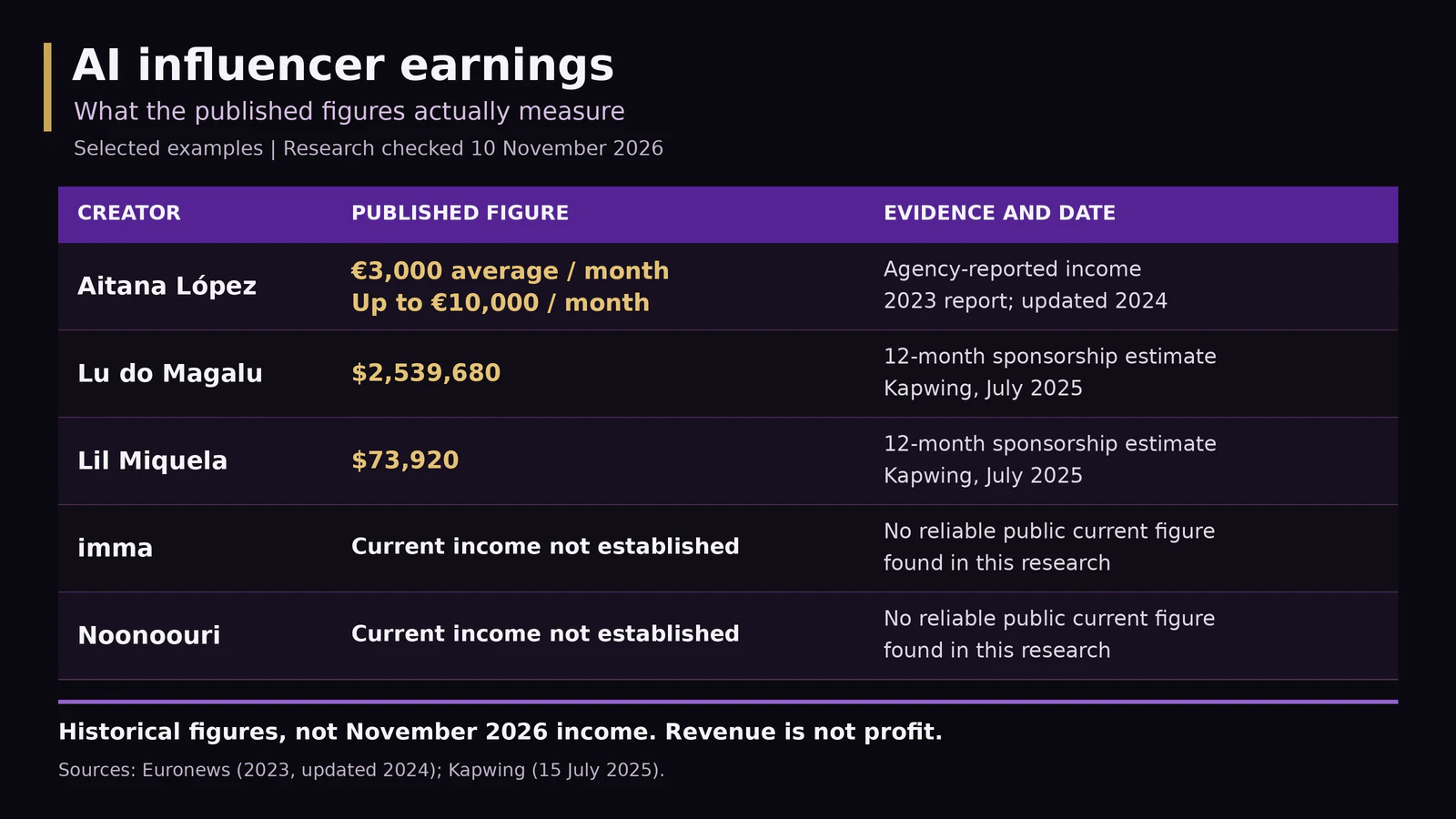
Aitana was created by Spanish agency The Clueless. In Euronews’ original reporting, published in November 2023 and updated in December 2024, her creators said she averaged around €3,000 a month, reaching up to €10,000.
These are historical, self-reported figures. They do not establish her current income or the profit remaining after production costs.
What should a beginner study? The agency describes planning her fictional life and building a personality around it. A repeatable editorial concept matters alongside visual consistency. Euronews
Lu do Magalu: a retailer’s long-running brand character
Lu represents Brazilian retailer Magazine Luiza. Ogilvy’s campaign case study documents her role across brand content, music videos and television. This is a character supported by an existing retail business and its audience.
Kapwing’s July 2025 analysis estimated $2,539,680 in Instagram sponsorship earnings over its preceding 12-month observation period. It modelled fees using follower counts and counted sponsored posts. It did not inspect Lu’s contracts or accounts.
The lesson is commercial fit: a character can become a continuing communication asset for a business. Lu’s infrastructure makes her a poor income benchmark for a solo beginner.
Lil Miquela: a virtual personality with music as well as influence
Lil Miquela is a longstanding virtual creator whose Bandcamp catalogue also illustrates a music-based identity.
The same Kapwing analysis estimated $73,920 in Instagram sponsorship earnings over its preceding 12-month period. Again, that is a modelled estimate for one channel, not confirmed total income, a current salary or net profit. Miquela
A useful takeaway is to give a character something to do beyond appearing attractive. A creative identity can support several kinds of content.
imma: recognisable design and professional brand work
Aww’s official profile identifies imma as a Japanese virtual model with a distinctive pink bob. The company’s website also lists her work in Coach’s 2024 global campaign.
This research did not establish a reliable public current-income figure. A recognisable campaign or luxury association does not tell us what a contract paid.
Study the strength of her visual identity. Instant recognition can come from deliberate design rather than extreme photorealism.
Noonoouri: a digital character spanning fashion and music
Noonoouri’s official site identifies Joerg Zuber as her creator and presents both fashion projects and music. She offers another useful example of a character with a distinct creative world. noonoouri.com
This research did not establish reliable public current earnings for her either. Music activity and partnerships demonstrate commercial routes, but they don’t reveal revenue, royalties or profit.
The creative lesson is to build a character with interests and a role that can sustain more than one post format.
How much money do AI influencers actually make?
There is no defensible single income figure for the category in the evidence reviewed here. Public information is selective, often historical and weighted towards successful examples.
The comparison below preserves those differences. Its figures are historical reports or estimates, not November 2026 earnings.
A reported monthly amount, a modelled annual sponsorship total and undisclosed contract income cannot be compared as if they were equivalent salaries.
Before trusting an earnings headline, ask who supplied the figure, when it applied, which revenue channels it covered and whether expenses were deducted. If those details are missing, treat the headline as a lead to investigate.
How AI influencers can make money
Possible business models include sponsored content, disclosed affiliate links, paid creative work for brands, digital products and licensing an original character. A retailer may use a virtual spokesperson to support its own sales instead of treating the account as a standalone sponsorship business.
Choose a model that fits the content. A fictional comedy host could support entertainment sponsorships. A character explaining design concepts could direct interested viewers to an original learning resource. These are possible approaches, not earnings forecasts.
Agree deliverables, usage rights and review responsibilities before paid work begins. A brand buying one post may want different rights from a brand buying reusable campaign assets.
Keep revenue separate from what you retain. Generation attempts, editing, subscriptions, licensed audio, contractors and platform fees can all reduce the amount left over. Views alone do not establish a profitable business.
A basic AI influencer tutorial: from idea to first reel
Start with a small pilot. The following is a recommended beginner workflow, not a promise of audience growth.
1. Choose an audience and a repeatable idea
Finish this sentence: “This character helps or entertains these people by doing this specific thing.”
For example: “An openly fictional design host turns everyday desk problems into short visual jokes for freelance creatives.” That gives you an audience, a subject and a reason for a series.
If you cannot imagine several different episodes, refine the idea before buying more software.
2. Write a short character guide
Define the character’s name, adult age, temperament, speaking style, visual traits and boundaries. Choose a few recognisable features that you can reproduce consistently.
Also decide what the character will never claim. A fictional host should not invent personal product experience, professional credentials or real-world events to appear credible.
An original identity gives you more creative freedom than copying an existing influencer’s face or persona.
3. Create reference images and review consistency
Choose an image-generation service whose current terms permit your intended use. Create a small reference set showing the same character from different useful angles.
Check facial structure, hair, proportions, clothing details and distinctive accessories. Save accepted references, project files and the settings you used. Features and reference controls vary between services, so check their current documentation.
Reject images that change the character’s identity. Making more pictures is less useful than creating a reliable starting set.
4. Write one short scene
Use a clear opening, a small complication and a payoff. For the fictional design host, a reel might begin with a cluttered desk, introduce an absurdly overcomplicated organising attempt and end with one practical simplification.
Keep the script short enough to finish well. Avoid relying on a long speech to explain a weak visual idea.
5. Produce and edit a simple reel
Start with a few stills or a short generated clip. Use a video editor to control pacing, add readable captions and incorporate audio you have permission to use.
Review every shot. Look for identity drift, inconsistent props, unnatural movement, illegible text and visual claims that the scene cannot support. Review the sound separately too.
You don’t need an elaborate production to test whether the character and story make sense.
6. Disclose, publish and learn
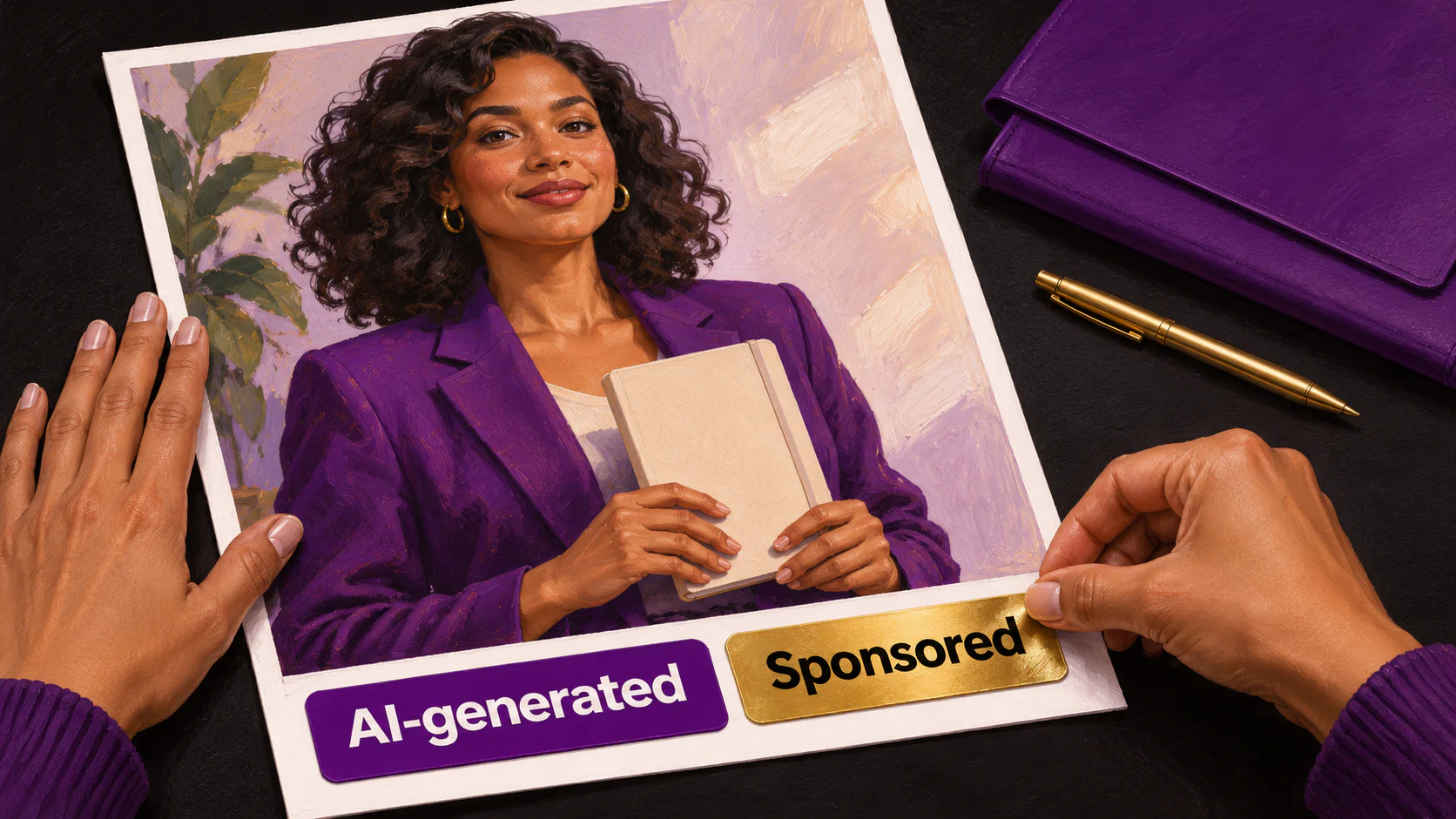
Identify the personality as fictional or AI-generated and apply the platform’s relevant disclosure settings. Disclose paid relationships separately when applicable.
Test a few variations of the same core idea. Compare viewing completion, shares, saves, useful comments and relevant enquiries where those measures are available. Keep a record of what changed so you can learn from the result.
Treat your first reel as a production and audience test. It is evidence to improve the next attempt, not proof of a future income stream.
Disclosure and trust belong in the workflow
The simplest editorial standard is to let viewers understand what they are watching and who benefits commercially.
According to 9to5Google’s August 2026 report, Instagram renamed its account label “AI-generated profile” and warned that unlabelled profiles featuring AI-generated people could lose recommendation eligibility. A bio description should not substitute for applicable platform settings.
YouTube’s May 2026 announcement confirms that creators must still manually disclose realistic AI use, even as the platform adds automatic detection and more prominent labels.
Advertising disclosure is a separate responsibility. The US Federal Trade Commission’s guidance calls for clear disclosure of material brand relationships and warns against claiming product experience you haven’t had. Other applicable local rules also need checking for the audience and campaign concerned.
For a fictional presenter, describe verifiable product features rather than inventing a personal testimonial. Check permissions for faces, voices, music and source material before publishing.
Common mistakes that make the project harder
Changing the character every post. A different face, personality or visual style makes continuity difficult. Keep the identity stable while testing stories.
Paying for complexity too early. Begin with one manageable format. Track production time and rejected generations before committing to a larger publishing schedule.
Chasing controversy instead of a useful identity. Attention built around misleading claims can damage the business you hope to create.
Copying a successful account’s surface details. Learn from its positioning and production discipline. Build your own creative reason to exist.
Want the full PDF guide and working toolkit?
For detailed production guidance, explore Market Me Global’s AI Influencer Blueprint.
The paid package includes an illustrated PDF guide, 40 prompt recipes, 12 adaptable reel scripts, seven worksheets or planners and an offline reel-cost and monthly-budget calculator. It is delivered together as a ZIP.
A free seven-page sample needs no email or account. Check the product page for the current price.
Production software and credits cost extra. The toolkit supports planning and execution; it does not guarantee followers, viral reach or income. Market Me Global
Key takeaways
- AI and virtual influencers are characters backed by human creative and commercial work.
- Famous-account earnings reports describe specific cases, dates and measurement methods.
- A consistent identity and repeatable story are useful foundations for a first account.
- Production costs, rights and disclosures affect the project from its first post.
- Test a small, honest concept before expanding the budget or publishing schedule.
Frequently asked questions
Are AI influencers real people?
How much does an AI influencer earn per month?
Can a beginner create an AI influencer?
Do I need to hide that the character is AI-generated?
What is the difference between an AI influencer and a virtual influencer?
Does the AI Influencer Blueprint include more than a PDF?
Build a character worth returning to
AI influencers offer a flexible way to experiment with entertainment, storytelling and brand communication. The lasting work is in the character, the editorial choices and the relationship with the audience.
Start with one recognisable personality and one clear scene. Publish transparently, review the response and improve the next episode. If you want structured help developing that workflow, the AI Influencer Blueprint PDF and toolkit is a practical next step to explore.