

Yes, AI can save businesses money when it reduces the total cost of producing useful, approved work. It can also increase costs when revisions, checking, integration and unnecessary usage outweigh the benefit.
An AI subscription is easy to buy. A reliable business workflow takes more thought.
The question is whether your company gets enough value from its AI spending. That means looking beyond the number of credits consumed to the staff time recovered, the quality delivered and the work you can now complete.
Here is how to assess the real return, where better prompts help, and why developing practical AI capability matters more than collecting tools.
What the research actually says about AI savings
There is credible evidence that AI can improve productivity. There is also evidence that the result depends heavily on the job.
A study published in The Quarterly Journal of Economics examined 5,172 customer support agents. AI assistance increased issues resolved per hour by 15% on average. Less experienced workers benefited more; the strongest workers saw smaller speed gains and some quality deterioration. This was a particular support system in one company, not a universal savings rate. academic.oup.com
In a different setting, METR's early 2025 randomised study involved 16 experienced developers completing 246 tasks in familiar projects. With the AI tools studied, completion took 19% longer. Participants nevertheless believed AI had made them faster. arxiv.org
That finding needs its date attached. In a February 2026 update, METR said newer tools likely helped developers more, but selection effects made the follow-up data unreliable for estimating the size of the improvement. Its May 2026 survey found substantial self-reported benefits among 349 technical workers, while explicitly questioning their magnitude. Reported gains are not audited cost savings. METR
The practical lesson is to measure your workflow. Neither an impressive demonstration nor someone else's slowdown tells you what will happen in your company.
Measure the cost of finished work
AI credits are platform-specific usage units. They are not a standard currency, and equal credit counts across different services need not buy equivalent work. Check what your own provider meters. For example, Adobe documents credit use by feature, model and output. Creative Cloud
AI ROI, or return on investment, compares the value gained with the resources invested. For an operating team, a useful starting measure is:
Cost per approved output = total workflow cost divided by the number of outputs that meet the agreed standard.
Count staff time spent preparing inputs, prompting, checking, correcting and finishing. Add attributable software, usage, integration and maintenance costs. Allocate initial training and setup across a realistic period, and show the upfront commitment separately.
Use comparable outputs. A checked proposal ready for a client is different from a rough draft. So is a working website compared with code that still needs debugging.
This prevents a common measurement error: celebrating faster generation while ignoring the work required afterwards.

Where the apparent savings disappear
Revisions are often the first warning sign. The model produces something quickly, then the team spends the afternoon correcting tone, replacing invented details or asking for the same missing requirement.
Other costs are less visible. Someone has to prepare source material, maintain integrations and check whether an automation still works after a change. Training uses paid working time. A tool that saves an hour for one person may create an hour of checking for someone else.
Before approving a workflow, ask:
- How much human time does one accepted result require from start to finish?
- How many generations or retries lead to that result?
- What happens when an answer is wrong, and who catches it?
- Which existing expense actually disappears?
Recovered time has value, but it is not automatically cash in the bank. If a salaried employee finishes earlier and the wage bill stays the same, you have created capacity. Cash savings arise when spending falls, for example through less overtime or a genuinely avoided external fee.
Additional sales are another possible benefit. Count the attributable contribution after delivery costs, rather than assuming every extra euro of revenue is profit. Keep that benefit separate from cost reduction so it is not counted twice.
A practical example: the same AI budget, different results
Consider an illustrative monthly scenario, not a client case study or a vendor price comparison.
A team needs 40 approved content items each month. Value staff time at an assumed €30 per hour, and hold the quality standard constant.
The manual process takes 60 minutes per item, making monthly labour cost €1,200.
An ad hoc AI process reduces human time to 45 minutes per item. Labour falls to €900, but an assumed €250 monthly allowance for AI and workflow overhead brings the total to €1,150. That creates only €50 of net capacity value against the manual baseline.
A managed AI process uses clear briefs, reusable prompts and defined checks. Assume it needs 25 minutes of human time per item. Monthly labour is €500. With the same €250 overhead allowance, the total is €750, creating €450 of net capacity value.
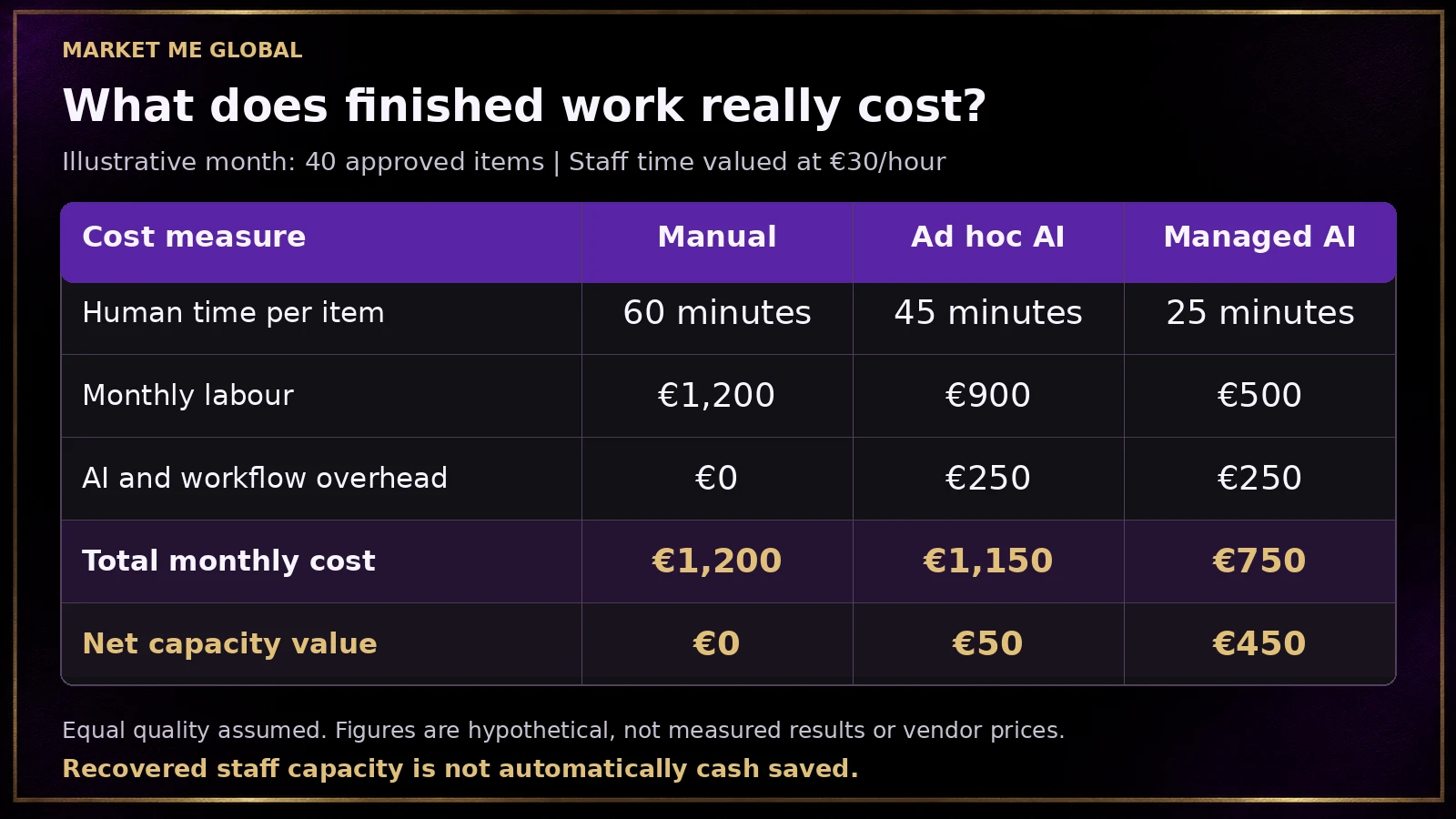
These figures are arithmetic under stated assumptions, not measured performance. The overhead allowance includes attributable subscriptions, usage and amortised setup or training; operational review time is already included in the minutes per item.
Both AI approaches use the same allowance. Their economics differ because one produces acceptable work with less human effort. Your own pilot must establish whether that improvement is achievable.
Can better prompts reduce AI credit spending?
They can, particularly when repeated failures come from missing instructions. The relationship is conditional.
Anthropic's prompting guidance recommends explicit instructions, relevant context, output requirements and useful examples. Its prompt engineering overview also starts with success criteria and empirical tests, and notes that some cost problems are better addressed through model selection. Claude Platform Docs
For a business task, a useful brief identifies:
- The result required and who will use it.
- The source material the AI should rely on.
- The format, length and important constraints.
- What an acceptable result must contain.
- How uncertainty or missing information should be handled.
That reduces avoidable guessing. It also gives the reviewer a clear standard.
However, a longer prompt may consume more metered input. Optimising a prompt can involve another model call. Generation-based credits differ from token-based billing for model inputs and outputs. A subscription with a fixed bill may deliver more capacity without reducing that bill. Claude Platform Docs
The useful question is whether the improved approach reduces total usage and human effort per accepted result. Fewer retries can help, but they are only one part of that calculation.
Also distinguish prompt failure from capability failure. If the task needs unavailable data or a capability the tool lacks, rewriting the instructions repeatedly may simply add expense.
Where AIQuickPrompt fits
AIQuickPrompt describes a prompt vault with folders, reusable variables and AI Optimise features for improving prompt wording. These functions can help teams preserve a brief that works and reuse it consistently. They do not, by themselves, establish a financial return. Organize Every AI Prompt
Its model recommendation feature suggests a recommended option and a more economical option within AI Optimise. For image and video work, the feature concerns writing the prompt text; it is not a guarantee about the downstream generator's cost or output. AIQuickPrompt
My recommendation is to test it on a task you repeat. Compare your existing brief with an optimised version, using comparable inputs and the same acceptance criteria. Record optimisation overhead, downstream usage, revisions and human review time.
If the optimised approach reaches the required result with less total effort and spend, keep it. No independent evidence reviewed for this article establishes a fixed saving from AIQuickPrompt. The claim to prove is reduced waste in your workflow, not a promised percentage.
Do successful companies need AI engineers?
Companies need the capability to make AI useful, reliable and economical. Whether that requires an employed AI engineer depends on the work.
A January 2026 BIS working paper on European firms estimated a 4% labour productivity increase from AI adoption. Benefits were concentrated in medium and large firms, and the authors highlighted complementary investment in software, data and workforce training. This is a research estimate, not a forecast for every small business or a 4% reduction in payroll. bis.org
An August 2026 discussion paper by Babina, He and Jiang also links AI-skilled employment and productivity growth to the accumulation of company-specific knowledge. It supports looking beyond tool access, although the association does not establish a universal hiring rule. CEPR
Neither study proves that only firms with AI engineers will survive or excel.
Match the capability to the job
A small business using AI to prepare drafts may start with a trained operations or marketing lead who understands the work and checks the result.
A company connecting models to customer records, deploying production software or maintaining complex automations may need engineering expertise. That could come from an employee, a specialist partner or a combination of both.
For those systems, practical AI engineering includes integration, evaluation, permissions, monitoring and maintenance. Prompt writing is one component. A technically impressive workflow still needs a business owner who can say whether it solves a worthwhile problem.
The recommendation is to assign responsibility for results and develop skills around real use cases. Hiring a title without changing the process is a weak investment thesis.

Build skills around a real business task
At Market Me Global Academy, I teach practical uses of AI for productivity and marketing. Chapter 2, Using AI to Increase Productivity, covers AI agents, business workflows, content repurposing and reviewing outputs for hallucinations. AI & Digital Marketing Academy
Treat that training as a starting point for applied capability. Choose a recurring task, learn a relevant method and test it against your existing process. Course completion alone does not establish professional AI engineering competence or guarantee savings.
The same principle applies to any training purchase: assess what your team can do afterwards, and what measurable improvement follows.
Run a small pilot before expanding
My recommended starting point is one recurring workflow with a clear acceptance standard, such as turning approved source material into a client report or preparing a draft proposal.
First, document the baseline. Record elapsed time, active human effort, external costs and the quality of the finished work.
Then test AI on comparable cases. Include awkward inputs and occasional failures, not just the easiest examples. Where practical, have a reviewer assess outputs without knowing which method produced them.
Track cost per accepted result, revision count, factual errors and turnaround time. Keep a record of the prompt version and tool used so a later change can be investigated. Use approved data and access permissions appropriate to the task.
For frequent work, two to four weeks can provide an initial operational check. That is a practical recommendation, not a statistically validated sample requirement. Infrequent or highly variable tasks need longer observation.
Expand when the benefit persists, quality meets the standard and someone owns maintenance. If the pilot fails, identify whether the problem is the task choice, the instructions, the tool or the process before spending more.
Key takeaways
- AI savings depend on the total cost of accepted work.
- Distinguish reduced cash expenditure from recovered staff capacity.
- Better prompts can reduce avoidable retries, but measure their net effect.
- AIQuickPrompt can support prompt reuse and optimisation; its savings require validation.
- Invest in skills and accountable workflows, with engineering expertise where needed.
Frequently asked questions
Does AI save businesses money automatically?
How should a small business measure AI ROI?
Do better prompts always use fewer credits?
Can AIQuickPrompt guarantee lower AI costs?
Must every company hire an AI engineer?
Can AI training replace engineering experience?
Make AI earn its place in your business
AI can save your company money. To find out whether it does, follow the work from the first brief to the approved result.
Develop practical skills through Market Me Global Academy and test reusable, optimised briefs with AIQuickPrompt. Keep the methods that demonstrate a worthwhile return for your business.
The strongest investment is a workflow your team can explain, measure and improve.