Tesla Reality View is a new live driving visualization announced with Full Self-Driving (Supervised) v15. It places a virtual camera above the vehicle and renders a third-person view of the road, nearby traffic and surroundings. The result has the cinematic feel of a driving game, but Tesla presents it as a way to see what FSD is planning, not as entertainment or autonomous driving.
Tesla introduced the feature in its official FSD v15 announcement on 21 November 2026. This guide separates the company’s public description from what remains unclear, and explains why the attractive graphics do not change the driver’s responsibility.
The quick answer
Reality View is a generative, virtual-camera view of a Tesla’s surroundings during FSD (Supervised). Tesla says it can help drivers see and control what FSD is planning to do. The public information does not establish that every detail on screen is a direct, complete or independently verified readout of the driving model’s perception.
It may make the vehicle’s planned movement easier to understand at a glance. It does not make a Tesla fully autonomous. Tesla says FSD (Supervised) still requires an attentive driver who watches the road and is ready to take over.
What Tesla announced about Reality View
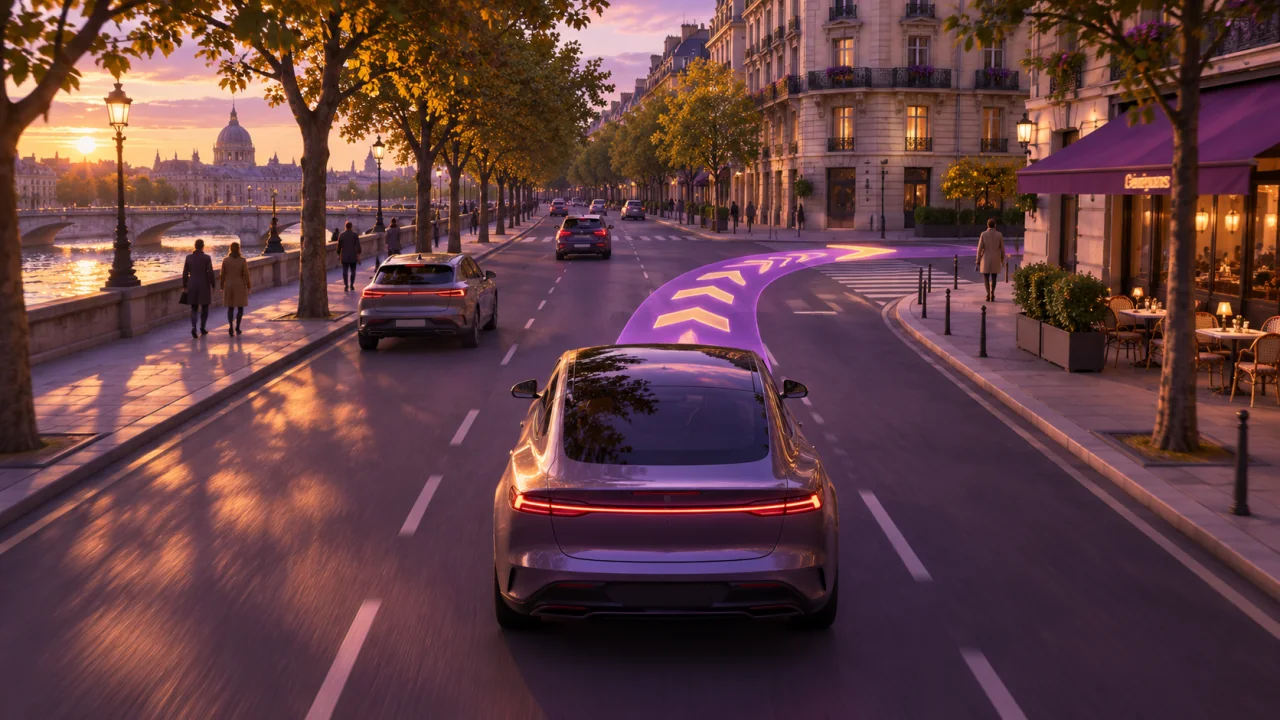
Tesla describes Reality View as a real-time generative driving visualization streamed from an arbitrary virtual camera above the vehicle. Instead of looking only at the car from inside the cabin or seeing simplified symbols, the driver can view a rendered street scene that includes the vehicle and elements around it.
The company’s announcement also describes a full-screen visualization, a split view with the map, and a quiet mode. Upcoming navigation turns can appear in the driving visualization. Tesla says the view is meant to let people see and control what FSD plans to do, although the announcement does not document every interaction or every vehicle configuration.
The GTA comparison is useful for understanding the camera angle: the car is visible from outside, moving through a continuous scene. The important difference is purpose. Reality View is a display for a supervised driver-assistance system, not a game camera and not a promise that the car can be left to drive alone.
What the rendered scene can and cannot tell you
A virtual camera can make road geometry and planned movement easier to picture. Tesla’s owner documentation says FSD uses vehicle cameras to build a model of the surrounding area. But the public announcement is not a full engineering explanation of how Reality View reconstructs every surface, object or movement.
That distinction matters. A generated scene is a representation. Its smoothness or realism does not, by itself, prove that the driving system identified every object correctly. The reverse also matters: if a detail is simplified or absent from a visualization, that alone does not prove the underlying model failed to detect it.
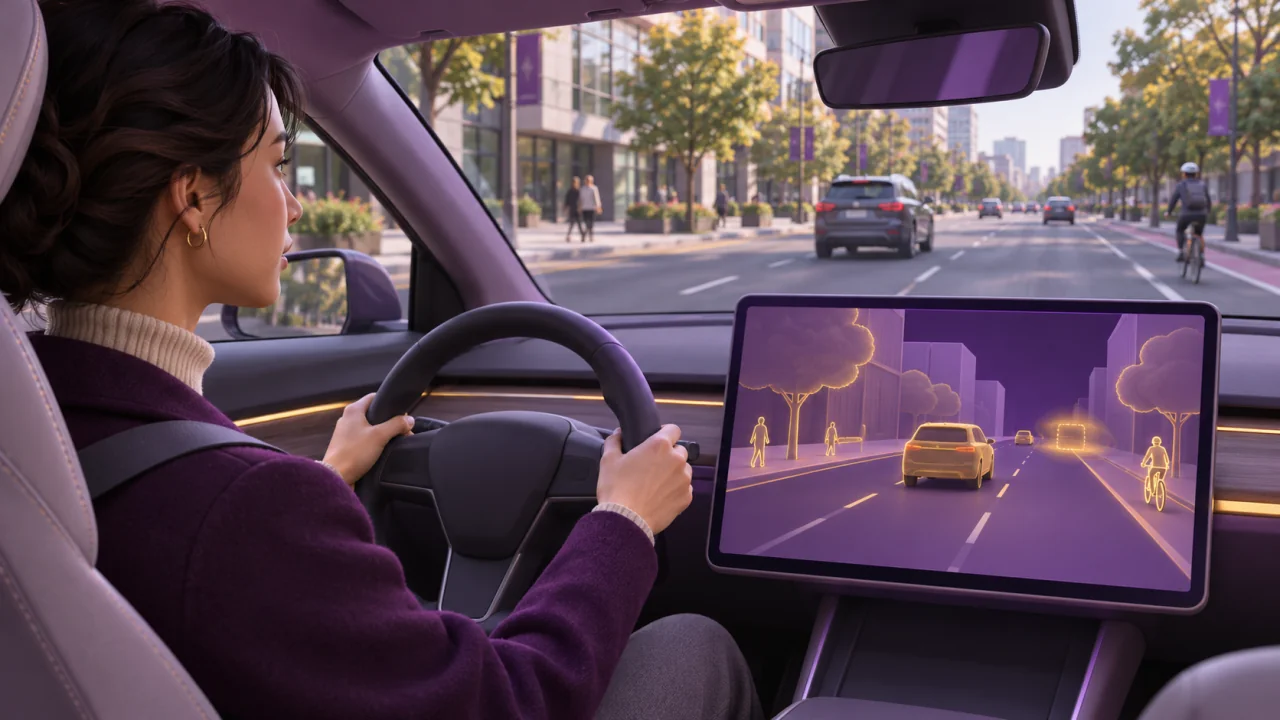
An independent look at the feature notes that the new generated view may be less direct as an audit of what the system has recognized than older, more symbolic visualizations. That is an analysis of the interface, not a published Tesla specification. For drivers, the practical rule is simple: use the screen as supporting information and keep checking the real road.
Why a third-person AI driving view could be useful
A driver already sees the road through the windshield, mirrors and cameras. The value of Reality View is not that it replaces those sources. It may help explain how the vehicle is positioning itself, what route turn is coming and how the system is representing nearby traffic.
- A continuous scene can be easier to interpret than several abstract symbols.
- An outside camera angle can help a driver understand the vehicle’s position relative to road edges and nearby cars.
- Route arrows and upcoming turns can make intended movement more visible.
- A selectable map or quiet view gives drivers a way to choose how much visual detail they want on the display.
These are interface benefits to evaluate, not proof that a particular driver will be safer or that the system makes better decisions. A new visualization should make the supervised task clearer without pulling attention away from the roadway.
Can you interact with the view and change what the car does?
Tesla’s public wording says drivers can see and control what FSD is planning to do, and it confirms that upcoming turns appear in the visualization. Some early reporting describes on-screen parking choices around AutoPark. However, public material does not establish that the rendered scene is a free-form joystick or that tapping any part of the image directly changes the car’s path.
Treat interaction as a set of specific controls that depend on the situation and software version. A route selection, parking target or display mode is different from asking an AI to improvise a maneuver. Read the vehicle’s on-screen prompts and owner guidance, and take over whenever the system’s behavior is unclear.
Does Reality View make Tesla fully autonomous?
No. Tesla calls the system Full Self-Driving (Supervised). Its support page says enabled features require active driver supervision and do not make the vehicle autonomous. The driver remains responsible for speed and control and must stay attentive and ready to take over.
A more realistic screen can create a stronger feeling that the car understands the whole scene. That feeling is not a reason to relax attention. Follow Tesla’s instructions, watch the road, and do not use the display as a substitute for your own judgment.
Who can use Tesla Reality View?
Reality View was announced as part of the FSD (Supervised) v15 rollout. Availability can depend on vehicle model, hardware, software version, region and regulatory approval. Tesla’s current support information cautions that specific features vary by configuration and market, so an announcement does not mean every Tesla receives the feature at the same time.
Check the software notes and the Self-Driving menu for your own vehicle. Confirm local availability and the feature’s operating instructions through Tesla rather than relying on a clip from a different model or region.
What Reality View signals about AI interface design
The larger idea reaches beyond cars. As AI systems take on more complex tasks, interfaces need to communicate both the action being considered and the evidence behind it. A polished visualization can make a system feel understandable, but visual clarity and technical transparency are not the same thing.
Useful AI interfaces should show what is planned, make uncertainty visible where it matters, and give people a clear way to intervene. Reality View is an interesting step in that direction. Its long-term value will depend on whether the display helps attentive drivers understand the system without overstating what the system knows.
Frequently asked questions
What is Tesla Reality View?
Is Reality View a real camera or drone following the car?
Can drivers touch the screen to control FSD?
Does Tesla Reality View mean the car is autonomous?
Does the visualization show everything the AI sees?
Which Tesla vehicles have Reality View?
The practical takeaway
Tesla Reality View is a striking example of AI changing not only how a vehicle operates, but how its intended behavior is presented to a human. The third-person camera makes the drive feel more legible and more like a game. The responsible interpretation is more measured: it is a generated aid for a supervised driver, with important details about its limits still to be clarified.
For the latest technical and safety information, consult Tesla’s FSD v15 announcement, FSD (Supervised) support guidance and the vehicle owner’s manual. This article was researched on 26 November 2026. Feature availability and documentation may change.
Sources and further reading
- Tesla: Introducing Tesla Self-Driving V15, official announcement video, 21 November 2026.
- Tesla Support: Full Self-Driving (Supervised), current capability and supervision information.
- Tesla Model 3 Owner’s Manual: Full Self-Driving (Supervised) and driver attentiveness.
- Car and Driver: Tesla’s Driver-Assistance Software Now Looks Like a Video Game, 23 November 2026.
- Not a Tesla App: How Tesla’s FSD V15 Reality View Actually Works, 23 November 2026.