
The short answer: can you trust AI detectors?
AI detectors can help identify writing that resembles AI output, but they cannot prove who wrote a document or whether someone broke a rule. Their reliability depends on the detector version, text length, language, writing genre and amount of editing. A useful result starts a review. It should not finish one.
The evidence in 2026 is more nuanced than either “detectors work” or “detectors are useless.” Some published tests show excellent detection of ordinary AI output and few false alarms. Other experiments expose substantial weaknesses with style imitation and mixed writing.
This guide compares five prominent tools, examines published tests of human, AI-generated and hybrid text, and explains what students, educators and publishers should do with the results. Research was checked on 10 November 2026. The comparisons below synthesise published experiments; they are not fresh scans conducted for this article.
How AI detectors work
An AI detector is a classifier that estimates whether text contains patterns associated with machine-generated writing. Unlike plagiarism checking, it does not need to find a matching source to produce a flag.
A detector can learn statistical relationships in vocabulary, sentence structure and context from labelled human and AI examples. For instance, Pangram’s technical explanation describes tokenising text, processing it through a neural network and predicting labels for text segments. It also describes retraining on difficult human examples to reduce false positives. Pangram
You will encounter explanations based on perplexity, a measure of how predictable text is to a language model, and burstiness, variation in writing patterns. These are useful background concepts, not a complete description of every modern detector. It is misleading to reduce the entire field to spotting predictable words.
A percentage can mean different things
Read the product’s definition before interpreting the number. GPTZero explains that its classification percentage represents confidence in a document-level class, not the percentage of sentences written by AI. GPTZero Support Center
By contrast, Turnitin describes its percentage as the share of qualifying prose its model identifies as potentially AI-generated or AI-altered. Its AI result is separate from its similarity score. Turnitin Guides
Consequently, “75%” from two different products may describe different quantities. Neither should automatically be read as a verified account of the writing process.
Why a convincing score can still mislead
Two errors matter:
- A false positive flags human writing as AI.
- A false negative misses AI-generated writing.
Recall measures how much actual AI text a detector catches. Precision measures how many positive flags are correct. Overall accuracy combines correct classifications, which can hide an important weakness if the test contains far more examples of one class.
Consider an explicitly hypothetical screening exercise. Among 1,000 submissions, suppose 20 contain prohibited AI generation. A detector with 90% recall identifies 18. If its false positive rate is 5%, it also flags 49 of the other 980 submissions. Only 18 of 67 flags, about 27%, would identify the targeted behaviour. These are illustrative assumptions, not measured results for any product.
A high score deserves careful reading, but the prevalence of the behaviour and the cost of an error still matter. Also, detection of AI involvement does not itself establish that the involvement was prohibited.
What independent tests show about AI detector accuracy
Human and fully AI-generated writing
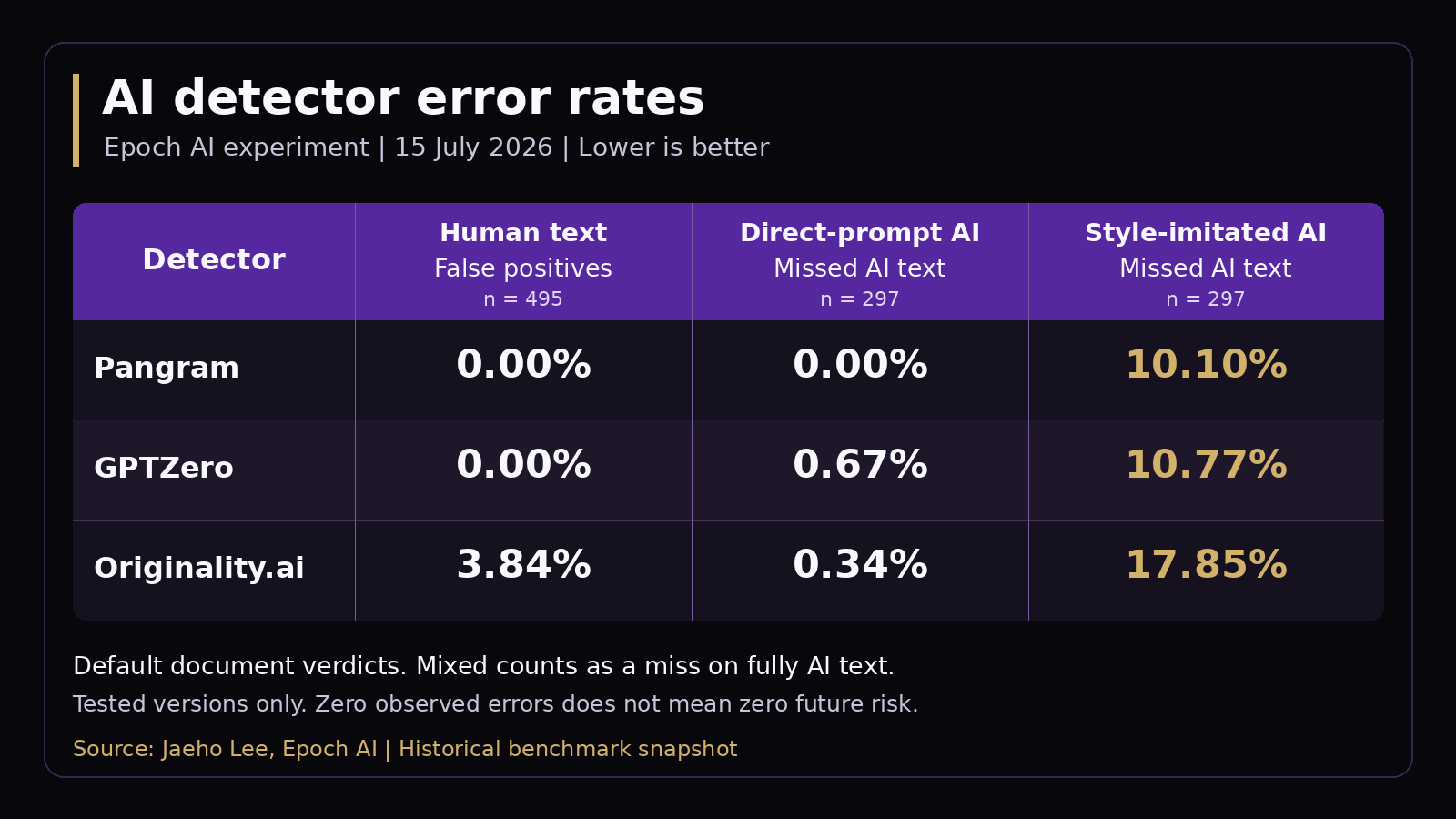
In Epoch AI’s July 2026 experiment, researchers tested Pangram, GPTZero and Originality.ai using 495 human passages and two sets of 297 AI passages. The human material covered blogs, fiction and scientific writing.
All three rarely missed basic-prompt AI text, but author imitation increased misses. The image gives the published rates.
Important qualifications: these were document-level default verdicts, and “Mixed” counted as a miss for fully AI-generated passages. Zero errors in a finite sample do not establish a zero real-world error rate. These are historical results, not measurements of every current release. Epoch AI
| Detector | Human text: false positives (n = 495) | Direct-prompt AI: missed AI text (n = 297) | Style-imitated AI: missed AI text (n = 297) |
|---|---|---|---|
| Pangram | 0.00% | 0.00% | 10.10% |
| GPTZero | 0.00% | 0.67% | 10.77% |
| Originality.ai | 3.84% | 0.34% | 17.85% |
Source: Jaeho Lee, Epoch AI, CC BY. Default document-level verdicts; a Mixed verdict counts as a miss for wholly AI-written passages. Historical tested versions only. No errors in a finite sample does not establish zero future risk.
Hybrid and revised writing
Hybrid writing combines human and generated prose. That differs from a person writing the argument and using AI only to revise wording, although both can produce mixed signals.
A 2026 academic experiment tested 160 documents, with 40 each in human, fully generated, hybrid and revised hybrid categories. Pangram performed best under the study’s scoring framework. For hybrid documents, strict accuracy was 92.5% for Pangram, 60% for Turnitin, 30% for Copyleaks and 0% for GPTZero.
Those striking figures need context. “Strict accuracy” required scores within document-specific ground-truth ranges, rather than merely noticing AI involvement. The study also evaluated different generating models across categories. link.springer.com
Its October correction clarifies that fully generated documents came from ChatGPT Deep Research mode, powered by an o3-based model; hybrid and revised passages used GPT-4o. Springer Nature Link
My interpretation: score calibration, generation method and task difficulty can change apparent performance substantially. Products also report different quantities, so percentage agreement should not be mistaken for a direct comparison of their intended tasks. These results are not interchangeable with document-level error rates, and neither establishes a permanent winner.
Comparing five prominent AI detectors in 2026
The following is a shortlist for evaluation, not a market-share ranking. Choose according to the work you need to review and the evidence available for that setting.
Turnitin: understand the qualifying-text boundary
Turnitin provides an instructor-facing AI Writing Report. Its current guidance requires at least 300 words of long-form prose and supports up to 30,000 words. Results above zero but below 20% are displayed as an asterisk without a numerical score or highlights because that range has a higher incidence of false positives.
Practical assessment: Useful where a review process already uses the report, provided reviewers understand its scope. Turnitin explicitly advises against using it as the sole basis for adverse action. A 0% result also cannot prove that no AI was used. Turnitin Guides
GPTZero: separate confidence from text proportion
GPTZero reports human, mixed or AI classifications with confidence information. Its October 2026 GPTZero 4o announcement describes a new model aimed at mixed and modified writing.
Practical assessment: Worth evaluating for document screening. The newer model announcement is vendor evidence. Do not silently attach older independent scores to GPTZero 4o, or treat confidence as a measured proportion of generated sentences. GPTZero Support Center
Pangram: examine the evidence for mixed authorship
Pangram performed strongly in the academic study. Its Pangram 4 technical overview, published in July 2026, describes distinguishing fully generated, mixed-author and AI-assisted text.
Practical assessment: A reasonable candidate for a local pilot where mixed authorship matters. Its latest technical overview also makes vendor benchmark claims, which need separate validation. Success on a particular study does not guarantee correct classifications for your students, contributors or languages. Pangram
Copyleaks: check language, sensitivity and test ownership
Copyleaks’ API documentation describes section-level classifications, an overall summary, configurable detection levels and support for 30 languages. Copyleaks API Docs
Its V11 methodology reports September 2026 testing by its own QA and Data Science teams. Separate internal teams can strengthen quality control, but this is vendor testing, not an external replication. Its English-language results should not be assumed to apply identically to every supported language.
Practical assessment: Relevant for multilingual or integrated workflows. Record sensitivity settings during evaluation, because changing the decision rule changes the comparison. copyleaks.com
Originality.ai: avoid comparisons based on retired models
Originality.ai’s current model history identifies 5.0 and 5.0 MAX as October 2026 releases and marks older product models as retired. It reports accuracy above 99% for the new releases, a vendor claim rather than a result independently established here.
Practical assessment: A candidate for editorial screening, with particular attention to human false positives during a pilot. Historical findings should not be presented as measured false positive rates for 5.0 or 5.0 MAX. Originality.AI
Who is most exposed to false positives?
A 2023 study by Liang and colleagues found that the detectors evaluated frequently misclassified writing by non-native English writers. Its date matters: it documents a fairness problem in those systems, not a current error rate for every 2026 release. arxiv.org
The appropriate response is to test relevant populations, not assume that either the old problem or a vendor’s claimed solution applies universally. Include multilingual writers and the genres you actually assess. A general blog benchmark cannot establish fairness for second-language academic essays.
There are also ordinary explanations for polished, uniform prose: a tightly prescribed format, technical subject matter or extensive revision. These possibilities should be investigated rather than treated as proof of generation.
Historical failures are useful context, too. OpenAI withdrew its experimental classifier in July 2023 because of low accuracy. That is not evidence that every newer detector fails; it is a reminder that confident classification needs validation. OpenAI
How to test a detector before relying on it
The following is a recommended local evaluation protocol, not a claim that new product tests were conducted for this guide.
- Define the target. Distinguish prohibited generation, permitted editing and disclosed assistance. A detector cannot decide your policy for you.
- Build a provenance-backed sample. Include verified human drafts, fully generated documents, human text with inserted AI passages and human text revised by AI. Record how each was created.
- Match real submissions. Use the relevant languages, genres and lengths. Meet each tool’s minimum requirements; do not compare a valid long-form scan with an unsupported short sample.
- Record the conditions. Save the date, detector version when exposed, settings, thresholds, inputs and original reports. Include several generating models and different amounts of revision.
- Blind the review. Hide the authorship labels from reviewers until results have been recorded. Keep evaluation material separate from examples used to tune thresholds.
- Report errors by group. Measure false positives, missed AI text, precision and recall. Separate uncertain verdicts from confident classifications. Evaluate hybrid labels separately from any claim about the proportion of AI text.
A handful of successful scans demonstrates that the service operates, not that it is reliable. If a clean human sample contains no errors, report its size and uncertainty. Repeat evaluation after material product changes, rather than treating a pilot as permanent certification.
What students, educators and publishers should do
Students: retain evidence of how the work developed
Keep outlines, research notes, source annotations and document revision history. Follow the assignment’s AI rules and disclose assistance when required.
If challenged, ask for the actual report, the applicable rule and the passages under review. Explain your reasoning and provide existing drafting evidence. Do not manufacture drafts or repeatedly rewrite solely to chase a lower score. A later clean scan would not establish the history of the original submission.
Educators: investigate the work and the rule together
Start with a neutral question about the flagged passage. Ask the student to explain an argument, discuss a source or walk through a revision. Consider the report alongside drafts and the assignment requirements, with a fair opportunity to respond.
Make permitted assistance explicit before submission. “No AI” and “grammar help allowed” require different decisions. A detector flag cannot resolve that ambiguity after the fact.
Vanderbilt’s 2023 explanation of disabling Turnitin’s detector illustrates institutional concerns about false accusations. It is historical context, not a claim about every university’s current policy. Vanderbilt University
Publishers: review factual quality and provenance
Set contributor rules for generation, editing and disclosure. Verify quotations, references and original claims regardless of a detector result. A human classification does not validate a source; an AI classification does not establish that an article is inaccurate.
If you screen submissions, use flags to prioritise editorial review rather than automatically rejecting writers. Before uploading unpublished or confidential work, check the service’s retention terms, contractual permissions and your organisation’s approved process.
Key takeaways
- AI detector accuracy is conditional on the test, version and decision threshold.
- False positives and missed AI text must be measured separately.
- Hybrid and revised writing require careful definitions and evaluation.
- A score is supporting evidence, not proof of authorship or misconduct.
- Clear rules, drafting records and human review make decisions more defensible.
FAQ
What is the most accurate AI detector in 2026?
Can human writing be flagged as AI?
Does 100% AI prove cheating?
Can detectors identify hybrid writing reliably?
Should I use several detectors to settle a dispute?
Can I still use OpenAI’s old AI text classifier?
Conclusion: trust a review process supported by evidence
AI detectors can be useful screening tools when their limits are understood and their performance has been checked in the relevant setting. The strongest practical question is not simply whether a passage looks generated. It is whether the available evidence supports a specific conclusion under a clear rule.
Use detector reports to guide that inquiry. Let the final decision rest on the work, its provenance and a fair assessment of what happened.
For related guidance, see how to reduce ChatGPT hallucinations and our comparison of ChatGPT, Gemini and Claude.