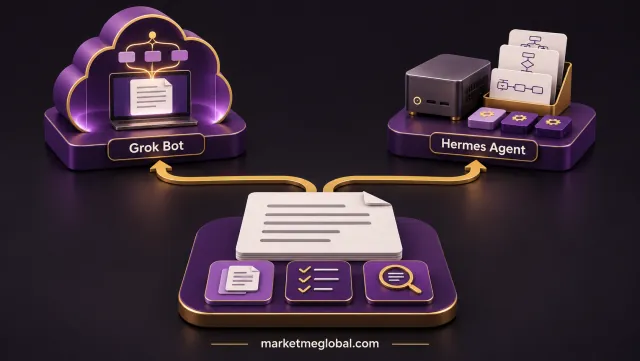

Managing AI agents means giving software systems clear objectives, the right information and controlled access to tools, then checking their work. For business owners, marketers and freelancers, it is becoming a practical skill alongside managing projects and people.
The change is already visible: instead of personally completing every research task, draft and administrative step, you can coordinate several focused agents. Your contribution shifts towards deciding what matters, setting standards and accepting the result.
That does not mean people management has disappeared. It means more work can now involve managing both people and AI. Learning to delegate well is increasingly useful, even if you work alone.
What is an AI agent, in plain English?
An AI agent is a software system that can pursue an objective through multiple steps, using tools and responding to what it finds. Depending on its setup, it might search documents, analyse a spreadsheet, prepare files or request approval before taking an action.
There is a useful distinction between an agent and a fixed automation. In Anthropic's explanation of effective agents, workflows follow predefined paths, while agents dynamically choose how to proceed and which tools to use. Neither approach is automatically superior. Predictable jobs often benefit from predictable workflows. anthropic.com
Several chat windows are not necessarily a coordinated AI team. If you manually carry information between them, you are handling the coordination yourself. A connected system needs a way to allocate work, exchange results and resolve failures.
You can still learn the essentials through a simple, supervised setup. Start by separating responsibilities and checking handoffs. The architecture can grow when the work justifies it.
Why managing AI agents matters now
Microsoft's 2026 Work Trend Index draws on a survey of 20,000 AI-using knowledge workers across 10 countries, alongside Microsoft 365 activity data. It describes a gap between what employees can do with AI and the systems their organisations provide to support them.
Its analysis connects reported AI value with workplace conditions such as management support, culture and opportunities to redesign work. Those survey relationships are associations, not proof of causation, and the sample does not represent every worker or business. microsoft.com
The practical implication is straightforward: buying access to AI is only the beginning. Someone must decide where it belongs in the workflow.
For a small business, that might mean identifying which parts of a weekly campaign are independent, which require approved facts and which need a personal conversation. These are management decisions, even when no additional employee is involved.
My recommendation is to treat agent management as a working skill: practise briefing, checking and improving a small process before expanding it across the business.

Real examples of work shifting towards agent management
There are documented examples, although company reports need to be read with their limitations in mind.
In its October 2026 study of employment inside Anthropic, the company describes a financial manager building an agent to review purchase requests and an executive assistant using an agent for scheduling and email triage. It also describes a product content team shifting from writing interface text towards prompting agents and developing evaluations.
These are examples of changing responsibilities, rather than evidence that an entire profession has become unnecessary. Anthropic studies its own unusually AI-intensive workplace, sells the technology involved and notes that adoption was not random. Its findings cannot establish a universal productivity effect. anthropic.com
A different example appears in Anthropic's research system engineering report. A task involving the board members of S&P 500 information technology companies benefited from splitting the investigation among agents. That illustrates a useful pattern: broad research can contain separate branches that do not need to wait for one another. anthropic.com
The common lesson is that a person still needs to define the question and judge whether the answers are useful.
Manual work versus an AI agent team
Imagine preparing a campaign for a new service. Working manually, you might research the audience, review competing offers, draft a landing page, write emails and prepare social posts yourself.
With an agent-assisted workflow, you first approve the service details and evidence. Independent research questions can then run in parallel. Once the findings are accepted, separate agents can draft the landing page, emails and social content from the same brief.
Drafting still depends on having reliable inputs. Running everything simultaneously would allow mistakes in the original offer to spread across every asset.
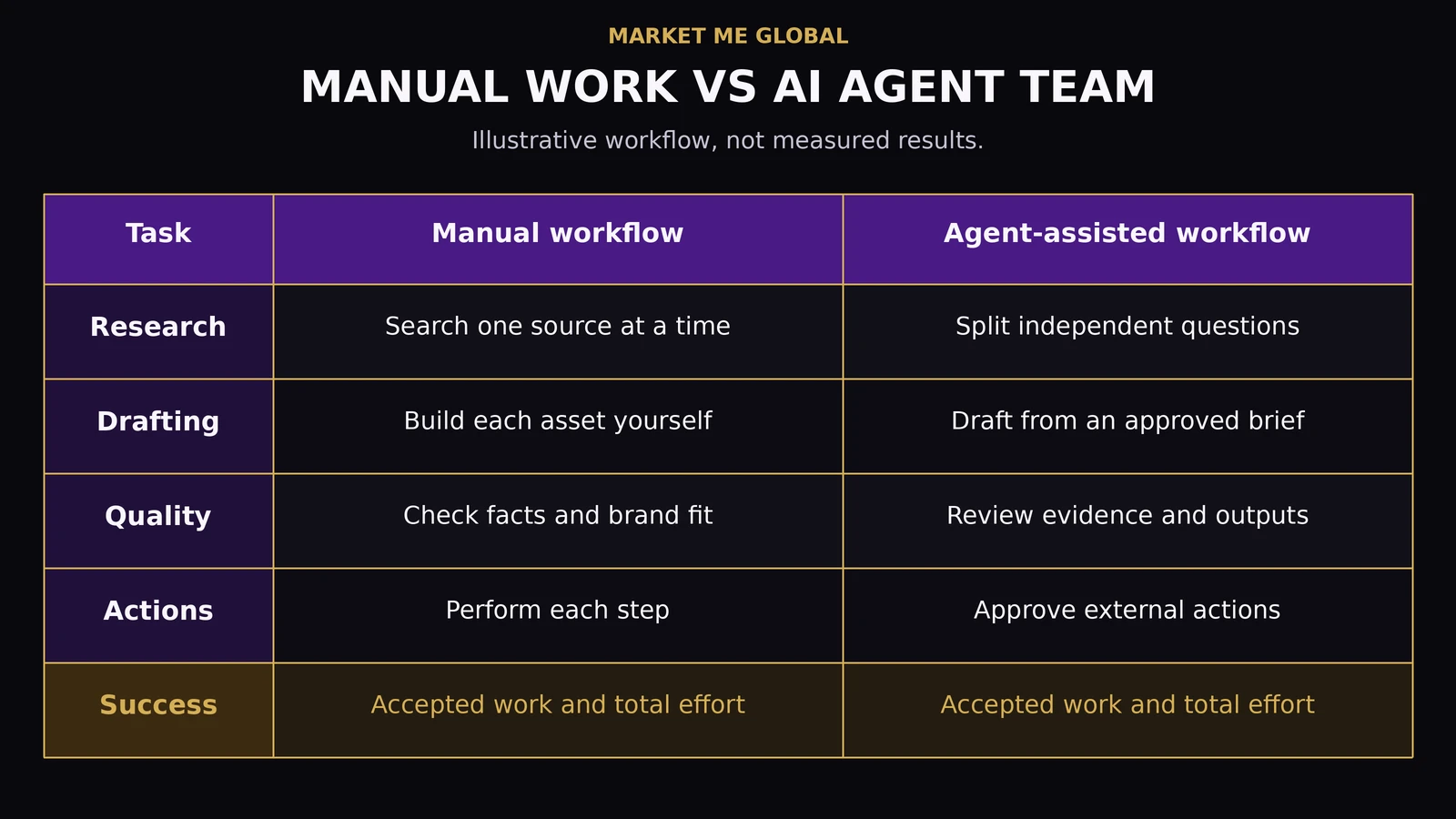
The comparison image below describes a suggested workflow, not measured results or a promise of faster delivery. Research can shift from searching one source at a time to splitting independent questions. Drafting moves from building each asset yourself to reviewing drafts made from an approved brief. In both approaches, success means accepted work and total effort, including corrections.
When several agents are worth using
Consider multiple agents when the assignment has independent branches, clear deliverables and enough value to justify coordination. Gathering information about separate markets is a stronger candidate than asking several agents to rewrite the same short sentence.
Anthropic reported a 90.2% improvement over its single-agent baseline on an internal research evaluation using its particular multi-agent configuration. It also reported roughly 15 times the token use of ordinary chat interactions. These are historical, system-specific findings, not current promises for your business. anthropic.com
The sensible question is whether the additional accepted work justifies the additional cost and review.
Three practical scenarios for a small business
The following scenarios are illustrative workflow designs, not client case studies or measured performance claims.
1. A marketing campaign from one approved brief
Start with the audience, offer, service boundaries, brand voice and permitted claims. Ask one research agent to investigate customer questions and another to examine competing offers, using accessible public sources.
After you check the findings, assign separate drafting roles for the landing page, email sequence and social posts. A reviewer checks consistency against the approved brief and flags unsupported claims.
You decide which promise the business can actually deliver. You also approve the final content before publishing or spending advertising money. The agents can prepare options; they should not invent testimonials, discounts or evidence to make those options more persuasive.
2. A property listing with fewer repeated explanations
A property professional supplies an approved information sheet: location, dimensions, features, availability and permitted photographs. One agent drafts the listing description, another prepares buyer FAQs and another adapts the material into social content.
All three use the same facts. Missing information stays marked as missing, rather than becoming a confident guess about sea views, ownership or investment returns.
The professional checks the finished material against the property records. This workflow is useful because several outputs share one factual foundation. It becomes unreliable if each agent receives a different version of the listing.
3. A weekly business review
A business owner provides a controlled export of sales, campaigns and customer support activity. Separate agents examine their assigned datasets and return a concise summary, evidence and unanswered questions.
The coordinator combines the results, but does not silently treat different date ranges or definitions as equivalent. If sales records and campaign figures disagree, the discrepancy becomes a question for the owner.
You review recommendations and decide the next action. A suggested budget change remains a recommendation until someone with authority approves it.
How to manage AI agents effectively
The following is a practical management framework. Adapt its depth to the task rather than turning every small assignment into a complicated system.
Define an outcome someone can check
“Help with marketing” is difficult to evaluate. “Prepare three email drafts for this approved offer, with no unsupported claims” gives you something concrete to accept or reject.
Specify the audience, format, source material, constraints and definition of completion. Say what should happen when information is missing.
Give each agent a distinct responsibility
Separate research, drafting and review when the separation serves a purpose. Avoid assigning several agents vague ownership of the same work.
Each task should have an expected output and a clear destination. If one agent needs another's findings, make that dependency explicit. Parallel execution is useful only where the tasks can proceed independently.
Maintain one approved source of facts
Create a shared brief containing the current offer, product details, brand requirements and approved evidence. Identify its version so that revisions do not leave half the team working from outdated information.
Request source links alongside research findings and keep assumptions separate from verified facts. A polished draft should never erase the uncertainty in its inputs.
Set boundaries before connecting tools
Decide what the system may read, draft, change and send. Begin with the smallest access needed for the job, using test data or copies where practical.
For an early pilot, require approval before external messages, publishing, payments, deletions or changes to live systems. Keep credentials out of ordinary task briefs. Treat instructions found in documents and websites as untrusted content, rather than permission to change the task.
Review evidence and the finished result
An agent checking another agent can help identify issues, but agreement between agents does not establish truth. They may share the same incorrect assumption.
Check important claims against original sources. For calculations, use reproducible spreadsheet or code checks. For content, inspect the actual draft for accuracy, brand fit and promises the business cannot honour.
Ask for concise results, unresolved questions and exceptions. You need enough detail to make a decision without reading an unnecessary transcript of every step.

Measure the result before expanding the system
Measure the whole job: setup, instructions, waiting, review, corrections and recovery. Also track tool spending and whether the final output meets the same standard as the manual version.
For an initial pilot, record elapsed delivery time, your hands-on effort, significant errors and accepted outputs. Compare several similar jobs, because one unusually easy assignment can give a misleading impression.
Research offers a useful warning about assumptions. METR's February 2026 update on developer productivity experiments explains that its early 2025 trial found experienced developers took 19% longer with the tools tested. Its later experiment suggested possible improvements, but selection effects and measurement difficulties made the current effect unreliable to estimate. METR
That does not prove today's agents slow everyone down. It shows why your own workflow needs measurement. Feeling busier, producing more text or running more agents is not the same as delivering better work.
Where to start learning
If the tools still feel unfamiliar, begin with the foundations. Market Me Global Academy's Chapter 1 on AI tools for beginners introduces tools including ChatGPT, Claude, Canva and CapCut within a marketing workflow. Best AI Tools for Beginners
Then explore Chapter 2 on AI productivity. Its published curriculum includes practical examples involving AI agents, content, reports, presentations, email and lead filtering, with attention to human quality control. Using AI to Increase Productivity
For practice coordinating several roles, Your AI Team Kit provides a playbook, role prompts, exercises and editable planning materials. It offers a structured way to practise moving from one approved brief to a reviewed package of work. Market Me Global Academy
Start with one recurring task in your own business. Learn the basics, build a supervised workflow and expand when the results justify it. Lessons can help you develop the method; they cannot guarantee a particular saving or replace the technical setup needed for every integration.
Key takeaways
- Managing AI agents involves defining outcomes, coordinating tasks and checking results.
- Independent tasks can benefit from parallel work; dependent tasks need deliberate handoffs.
- More agents bring additional costs and review requirements, alongside potential benefits.
- Keep human responsibility clear and measure accepted work, total effort and errors.
Frequently asked questions
Do I need coding skills to manage AI agents?
Can one person manage several AI agents?
Are multiple agents always better than one?
Can AI agents replace a whole team?
What is a good first project?
Start with one workflow you can trust
Learning to manage AI agents is a practical investment in how you organise work. Begin with a clear brief, allocate responsibilities carefully and insist on a result you can verify.
As more execution becomes available through AI, your judgment determines what deserves doing and what is ready to use. Build that skill deliberately, one useful workflow at a time.